Geography and the roots of Chinese fragility
On China I — The Ancient Condition
What happens when China fractures? The question feels premature. China is the world’s second largest economy, the dominant manufacturer of nearly everything, the primary trading partner of more nations than any other on earth. Its military budget has grown for three consecutive decades. Its navy has more hulls than America’s. Its technological ambitions are real, its investments vast, and its influence extends across every continent. To raise the question of fracture feels impertinent. It isn’t.
The assumptions embedded in American strategy rest on a China that continues to rise. That China is becoming harder to find. What is emerging in its place is a country with a geography perpetually on the verge of exhaustion, an economy built on conditions that no longer exist, a demographic profile in freefall, and a political system that has eliminated the mechanisms it would need to adapt. In short, China is fracturing. China has been fracturing. American strategy has not noticed.
Why? Perhaps the instruments we use to measure national power are better calibrated for rise than for decay. Perhaps in Washington, “counter-China” has become both a career path and one of the few reliable sources of bipartisan consensus, both of which depend on China’s threat remaining large and legible. Or, perhaps, an honest accounting of China’s structural fragility would require confronting America’s own. The world’s perfect producer and the world’s perfect consumer are mirror images, bound by a single system, one that is now breaking.
All of this can be true simultaneously. What matters is that China is significantly weaker than the zeitgeist would have us believe, and that the gap between the country American strategy is preparing for and the country China is becoming grows wider every year.
This series of essays argues that China’s structural fragility is more consequential than its strategic ambitions, and that American policy has systematically misidentified the threat. The pillars of Chinese fragility, its geography, its economy, its demography, and its political system represent challenges that cascade into each other, each failure loading additional stress on the next, compounding in ways that the standard threat literature has not seriously modeled.
The danger this produces is a contracting China destabilizing the postwar order from within, through contagion, fragmentation, and the vacuum its retreat leaves behind. American strategy has been organized around an adversary that expands. The more plausible planning scenario is one that sees China contract. This series is an attempt at reorientation toward that reality.
The Ancient Condition
The North China Plain is where Chinese civilization began and where it has always been most fragile. It is a vast alluvial lowland, roughly the size of France, built up over millennia by the sediment of the Yellow River as it descends from the Tibetan Plateau and fans out across China’s interior. The soil of the plain is deep and workable. The growing season is long enough to sustain dense agricultural settlement. For a civilization learning to feed itself five thousand years ago, it was the closest thing the Asian landmass offered to a natural granary.
But civilizations do not only require productive soil to form and flourish. They also need a landmass amenable to administration, and the North China Plain provides this. The plain is remarkably flat, which makes the basic operations of administration easier for a fledgling state. Roads can be built more simply without the need to traverse mountain passes or bridge large bodies of water. Roads provide the means for commerce and communication between settlements, and what is a civilization if not a group of people bound together by the mutual exchange of goods and ideas?
Its flatness also permitted the movement of armies en masse, meaning whoever controlled the army could compel a growing network of towns toward further administration. The plain, in short, was fertile but also governable. It is the basic fact that made the idea of “China” as an administrative entity conceivable in the first place.
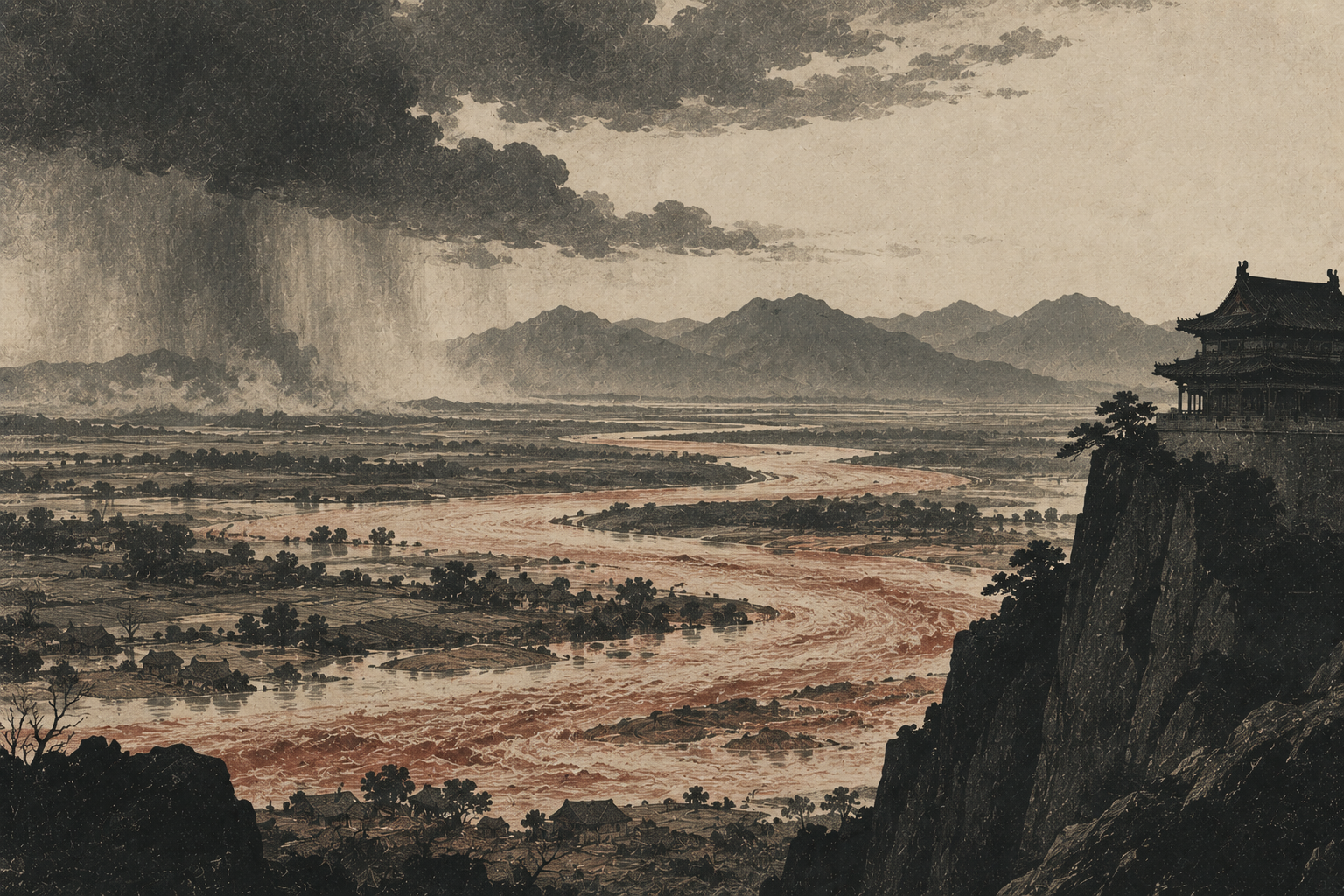
But the North China Plain, the source of Chinese civilization, is not a reliable partner. The Yellow River floods catastrophically, shifts course without warning, and has done so repeatedly across recorded history. In the past three thousand years it has changed its primary course more than twenty times, on several occasions dramatically enough to relocate its mouth by hundreds of miles.
The plain also sits in a semi-arid climate zone whose rainfall arrives in a narrow summer window. A monsoon that arrives late, weak, or tracks slightly off course can cause an entire harvest to fail, sometimes for years on end. When drought parches the land, locusts follow. What makes the plain governable, its flatness, its uniformity, also makes it the ideal breeding ground for locusts, who despise diverse landscapes and thrive off the monocultures of agricultural settlement. Under the right conditions, locust populations can explode across the plain, producing swarms large enough to darken the sky, clouds of buzzing insects that devour every form of sustenance the land provides.
The combination of flood, drought, and locust appears in the historical record of China with grim regularity, most of the time in the years preceding a dynasty’s collapse. Despite the plain’s unreliability, ancient Chinese farmers learned to produce in its floodplain because there was no alternative. The plain was what China had, and in many years the plain was able to produce spectacular abundance, the kind that fills granaries, expands cities, and centralizes power. The plain’s cruelty is that it produces this abundance with such extravagance that it calls into existence the very population it is capable of starving. And it has starved populations. It withholds its abundance with regularity.
This is China’s ancient condition, the most basic fact of Chinese political life, the ever-recurring pendulum that shifts China between order producing abundance and order destroying scarcity. Call it what it is: a recurring provisioning crisis, chronic, structural, and without resolution. The North China Plain can reliably produce populations, but it cannot reliably sustain them.
The search for alternatives to the North China Plain does not provide ready answers. The Yangtze River valley to the south is fertile but is interrupted by hills and mountains and resists administration. The northwest of China is arid steppe where agriculture is impossible. The southwest is mountainous and tropical. The northeast is cold and short-seasoned. The Tibetan Plateau is uninhabitable at scale.
The geography of China offers no other granary aside from the North China Plain, no other fallback. So, when the plain fails, the state has nowhere to run. And the plain has always, eventually, failed. The result is China’s obsession with scarcity. Every major decision in Chinese statecraft throughout history can be traced, directly or indirectly, back to the ancient condition. Resource management is the foundation of China’s strategic consciousness.
The Mandate
There is a reason the Western reader can name so many Chinese dynasties. Most civilizations produce one or two before achieving durable statehood. China produced a dozen because durable statehood kept collapsing. The Han Dynasty fell in 220 AD after decades of Yellow River flooding and epidemics produced the Yellow Turban Rebellion, a peasant uprising drawn from farmers ruined by failed harvests. The Tang collapsed in 907 AD after the Huang Chao rebellion, which was rooted in agricultural failure, and the subsequent inability of the state to provision its people. The Ming fell in 1644 after decades of drought across the North China Plain again starved peasants into rebellion. The Qing’s long decline accelerated sharply after catastrophic Yellow River floods in the mid-nineteenth century, which resulted in the Taiping Rebellion, the deadliest civil war in human history, one that killed between thirty and fifty million people.
The Qin, the Han, the Tang, the Song, the Ming, the Qing, each rose, each consolidated, and eventually fell. And the accounting, traced back far enough, always returns to the same ledger. A harvest that failed. A river that moved. A center that could no longer supply what the periphery required to stay loyal.
The Chinese themselves had a name for this cycle long before Western historians began cataloguing it. When a dynasty unified the realm and maintained order, it held the Mandate of Heaven. When it lost its capacity to govern, when the harvest failed, when the armies went unpaid, when the peasants rose, it had lost the Mandate, and its fall was not merely inevitable but legitimate. A new dynasty would claim the Mandate, consolidate, and begin the cycle again.
China is a continuous civilization, but continuous is not the same as unified. Fracture and fragmentation have been just as constant a feature of Chinese history as the dynasties that temporarily overcame it. Of the roughly three thousand years of recorded dynastic history, historians estimate that China has spent as many as one thousand years in a state of genuine fragmentation. That figure does not count the centuries in which Chinese “unity” existed on paper while an infant dynasty was in the early stages of consolidation or a geriatric dynasty was actively losing its grip. The unified China of Western imagination is, in reality, a recurring achievement because the default has always been fracture.
A civilization that has spent three millennia managing recurring provisioning crises develops a particular relationship with the world beyond its borders. It is not paranoia in the clinical sense, but something closer to a rational conclusion of a state that has repeatedly discovered, at enormous cost, that weakness invites predation.
North and west of the North China Plain lies the steppe, a seemingly endless interior grassland that stretches from Manchuria through Mongolia and Central Asia. It is one of the largest continuous land surfaces on earth. It produced no great cities, no agrarian surplus, and no fixed administrative centers because its soil would not support them. What it did produce were mobile peoples whose survival depended on movement and whose prosperity, when it came, often came at China’s expense.
The peoples of the steppe acted when China was vulnerable. A weakened dynasty, a famine year, a court distracted by internal rebellion were all signals legible to any group living close enough to the Chinese border. The Xiongnu, the Mongols, the Jurchen, and the Manchu all pressed in when China looked like it could not push back, and most of the time this paid off. Sometimes the invaders founded their own dynasties on Chinese soil, sometimes they simply raided and took what a weakened China couldn’t protect.
Over centuries, this dynamic produced a civilizational reflex, a permanent orientation, the knowledge, absorbed deeply enough to feel instinctive, that the moment China’s internal condition deteriorated, its neighbors would notice. The outside world did not need hostile intent to become dangerous, only opportunity. And opportunity, in the case of China, was ever-present. This is the reason for the Great Wall, China’s most recognizable monument. It was built to secure China’s border with the steppe. It is not, as it is usually understood, a monument to Chinese strength, but to its preoccupation with its own weakness. Empires that can project power have no use for walls.
Neighborhood
China’s neighbors today are different in character but not in implication. To the north sits Russia, a partner of convenience whose alignment with Beijing is newer and shallower than its current presentation suggests. The two countries share a border that stretches for more than two thousand miles, and for much of the twentieth century that border was one of the most dangerous in the world. The Sino-Soviet split of the 1960s produced, in March 1969, genuine war as Soviet and Chinese forces fought a sustained border engagement along the Ussuri River.
The clash was serious enough that Soviet planners raised the possibility of a nuclear strike on China and may have done so without American assurances that such a strike would not be tolerated. This was a nuclear near-miss between two nominally communist states that shared an ideology and a border. Vladimir Putin and Xi Jinping were both sixteen at the time. It is not difficult to imagine the event capturing the attention of two politically alert young men coming of age inside the systems that nearly annihilated each other. The current alignment between Beijing and Moscow is real, but it is a tactical convergence of two revisionist powers who have found it useful, for now, to not be enemies. That is a very different thing from friendship, a difference both sides certainly understand.
To the south and west, India, with whom China fought a border war in 1962 but never resolved the territorial disputes that caused it. The two countries returned to the same disputed terrain as recently as 2020, when soldiers from both sides were killed in hand-to-hand fighting in the Galwan Valley. The confrontation produced no resolution and left the underlying geography as contested as it has always been.
To China’s southeast lie the nations of ASEAN, important trading partners with their own calculations about how close to stand to Beijing. Among them, Vietnam deserves particular attention. Vietnam’s relationship with China is structurally adversarial. The narrow nation spent roughly a thousand years under intermittent Chinese domination before achieving independence in 938 AD. Its subsequent national identity was forged in significant part explicitly against Chinese power.
In 1979, China launched a ground invasion of Vietnam to punish the Vietnamese for overthrowing the Chinese-backed Khmer Rouge in Cambodia. The invasion lasted a month, achieved none of its stated objectives, and ended with Chinese forces withdrawing having suffered casualties that exposed serious deficiencies in the PLA. Xi was a junior figure in the military apparatus at the time. The war is within the professional memory of the men currently governing both countries.
To China’s east Japan, South Korea, and Taiwan, all of them American treaty partners or close security partners, positioned across the same coastline that contains China’s most productive cities. No relationship in China’s modern consciousness runs deeper or cuts sharper than its relationship with Japan. For most of recorded history, Japan was China’s cultural student, absorbing its writing, philosophy, and administrative models over centuries of one-sided cultural exchange.
That relationship inverted sharply in the nineteenth century with the Meiji Restoration, and the inversion was violent. The wounds of Japanese occupation during the Second World War, and the atrocities that accompanied it, especially those committed by the Japanese in Nanjing, remain very much alive in Chinese national memory. No rival has cut China so deeply, precisely because no rival began from a position of such acknowledged debt. That Japan, once China’s student, is now remilitarizing under the tutelage of its greatest rival is not lost on Beijing.
This all amounts to one indisputable fact. There is no direction from which China looks out and sees reliable friends. There are only states with interests, many of them armed, most of them aligned with Washington. China’s geography therefore does not simply deprive it of a stable resource base, it also ensures China’s encirclement. Since Mao’s death, every military conflict China has entered as an active belligerent has been against a neighbor. Vietnam, Russia, India, and Taiwan, through coercion if not sustained combat. Throughout modern China’s existence, it has fought, repeatedly, and with mixed results, against the people next door. Xi grew up in this environment. He does not have an abstract strategic anxiety, developed through formal academic courses in international relations. He has a lived experience. China, and its neighbors, do not get along.
Americans find this psychology difficult to inhabit. The U.S. has lived almost its entire national life behind two oceans and beside two neighbors it has not seriously feared in two centuries. Its strategic culture was built under conditions of such profound geographic security that American analysts simply can’t comprehend the psychology of encirclement as a felt reality.
Consider America’s geographic inheritance, which is the mirror image of China’s, a near-perfect inversion. The U.S. has two ocean buffers, where China has only exposed coastlines. The U.S. has two non-threatening neighbors where China has contested borders on nearly every front. The U.S. has the world’s largest contiguous zone of arable land, its Midwestern breadbasket, while China feeds one fifth of humanity on just seven percent of the world’s farmland, which itself is not stable. The U.S. has domestic hydrocarbon reserves that make it energy independent while China imports more crude oil than any nation on earth. American abundance has produced a nation of extreme confidence, while Chinese scarcity has produced a nation of extreme vigilance. The divergence is total, and yet the resemblance is equally striking. Both nations are the fullest expression of their geographic endowment.
Resources
That geographic endowment still shapes China today. As noted above, China feeds roughly twenty percent of the world’s population on approximately seven percent of the world’s arable land. That ratio has held, but the agricultural methods required to maintain it have degraded the soil of the North China Plain.
Roughly a quarter of China’s farmland carries measurable levels of heavy metal contamination, the legacy of decades of industrial runoff and excessive fertilizer application that boosted yields while poisoning the ground beneath. The topsoil of the plain is thinning. Erosion, salinization, and desertification have removed tens of millions of hectares from productive use over the past half century. China is now the world’s largest importer of soybeans, and its dependence on foreign grain and agricultural inputs has grown steadily as domestic agricultural capacity has eroded. The land is no longer sufficient to feed the civilization built on top of it. The Mandate is slipping and is only being held in place by a steady stream of food imported from abroad.
Energy constraints compound China’s problems in ways that have no historical precedent. China sits on substantial coal reserves and built its industrial economy around them. But coal cannot power a navy, fuel a trucking fleet, or run the petrochemical industry that underpins modern manufacturing. For oil and gas, China depends structurally on imports, and that dependence has deepened as the economy has grown. It now imports more crude oil than any other country on earth. The sources of that oil are distant, and the routes are exposed.
The majority of China’s hydrocarbon imports transit the Strait of Malacca, a passage between the Malay Peninsula and the island of Sumatra roughly two and a half miles wide at its narrowest point. Chinese strategists have named the vulnerability this creates the Malacca dilemma. The dilemma is straightforward. China’s industrial economy runs on imported hydrocarbons. Roughly eighty percent of those hydrocarbons travel through the chokepoint of Malacca, a chokepoint China does not control, cannot easily bypass, and cannot defend against a serious naval adversary. A blockade of Malacca would begin starving China within weeks. The entire productive capacity of the world’s largest manufacturer rests, in the final analysis, on safe passage through a strait two and a half miles wide.
But the dilemma is not really about Malacca specifically, nor is it simply about energy, be it in the form of food or fuel. It is about the broader reality that China’s survival, in nearly every dimension, depends on sea lanes it cannot secure. The Strait of Hormuz sends the Persian Gulf oil that feeds Chinese industry through the Strait of Malacca towards Chinese import terminals. Both straits are narrow and become increasingly contested every year.
The same routes that carry inbound hydrocarbons also carry inbound food which China depends on to feed its population. The exports that sustain the Chinese economy flow outward along these routes as well. The sea lanes are therefore the circulatory system of Chinese society. Each of these passages is governed by a different set of political dynamics, but they share a common feature. China does not patrol them, does not control them, and has no navy capable of protecting them against a serious adversary. The sea lanes that keep China alive are kept open by the American navy. And the American navy may one day find it is in its interest to close any strait it wants.
This is the modern inheritance of the ancient condition. The North China Plain is no longer the sole guarantor of Chinese survival. China now feeds itself through global commodity markets and powers its industry through distant oil fields. But the trading order that made this possible, that allowed China to substitute imported soybeans for degraded farmland and Persian Gulf oil for coal, is the same order that can be turned against it.
The ancient condition of old was a floodplain that could not be trusted. It manifests itself today as a globalized system that simultaneously provides China with enormous capacity, and enormous risk. The ancient dynasty that could not supply the periphery from the North China Plain lost the Mandate. The China of today that cannot secure its own supply lines from the outside world it now relies on faces the same exposure at greater scale. The North China Plain has been replaced by the ocean. The ocean belongs to someone else.
Geography, then, is where the story of Chinese fragility begins. The resource constraints are real, measurable, and deepening. The psychological inheritance of encirclement is legible in every major foreign policy decision Beijing has made in the past three decades. But geography alone does not determine outcomes. It sets the terms under which everything else must operate. And the terms it has set for China’s economy are severe.