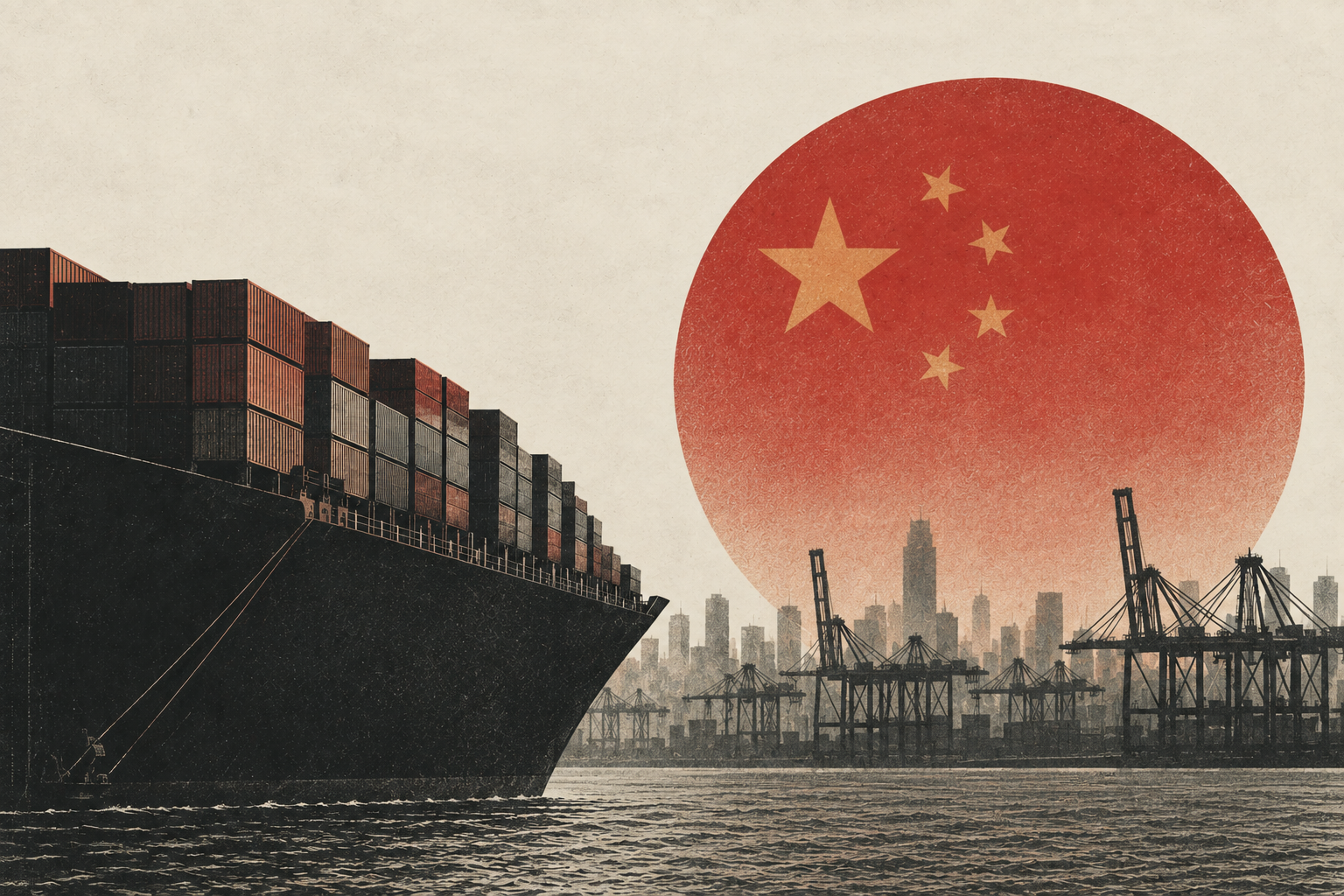
The model that saved China, and the trap inside it
On China II — The Export Machine
Beijing, May 1980. The man from the agriculture ministry has been speaking for six minutes and has not yet said the word you are waiting for. He describes the frost, the affected prefectures in Hebei and Shandong, the wheat already up when the temperature dropped. He describes the statement of reassurance his team is drafting for the people in the countryside, to be issued tomorrow, and then the assessment that will take place in the coming weeks to determine how much of the grain has been lost.
Your thumb moves across the river stone you’ve kept in your pocket since you were a girl, worn smooth by a lifetime of nerves you’ve always had to keep to yourself. The word he is not saying is failure. He has said damage, and potential shortfall, and impact on projected output. But he has not brought himself to say failure. So, you follow the contours of his words to the place he refuses to go. The harvest may fail. A failed harvest must be made up from somewhere, and there is no somewhere inside China this year. The grain will need to be purchased from foreigners, who will not accept payment in renminbi.
“In the event the shortfall is severe,” the minister says, “it may become necessary to consider procurement from external sources.”
“How much?” the Director, your superior, asks.
“If the losses reach the upper range of what the prefectures are reporting,” the minister says, “and I want to be clear that this is not an official projection, we may require something that could approach six million tons of grain.”
You should write the number down. The others are writing it down. A woman at your level who does not take notes when a minister gives a figure is remembered for it. But your pen stays where it is. Six million tons of foreign grain is not so much an agricultural figure as it is a foreign currency obligation, and foreign currency is what you do. You have managed the reserve position for over a year. You don’t need to look it up.
China’s holdings of foreign currency are negative. Not small, or insufficient, but negative. China owes more of other people’s money than it possesses, and the men around this table nodding at the word procurement do not appear ready to understand that. There is nothing to buy the grain with. You could write down six million or six hundred million. It would make no difference.
The meeting, you know, will end, and nothing will be decided, because deciding would require someone to say plainly that China’s plans have failed, and that China’s position is untenable.
At best they will tip-toe around the conclusion. Four years ago, you would have tip-toed around it too, and you would have been right to do so. But Mao is four years dead, and Deng Xiaoping, the man who has taken his place, has expressed an openness to new ideas to revitalize the economy. No one is sure how far that permission runs or if it extends to the people at this table. You certainly don’t have answers. But you do know that the walls are finally collapsing, and the state can no longer avoid running for the exit door, regardless of what’s on the other side.
Searching for a Model
China, in 1980, was facing the same ancient condition it had always faced. Too many mouths, the land at its limit, the nation still poor despite its most fervent efforts. But for the first time in a generation the political space to point to the failures of the communist system, and to act on them, had cracked open. Mao was dead. Deng was consolidating. And the Chinese political system, long accustomed to the miasma of ideology, was ready to breathe more practical air.
Practicality, however, requires practitioners, and China did not have them. For thirty years the study of economics in China had meant the study of one economics, the Marxist and Soviet planning variety, to the exclusion of everything else. The men and women trained in China were therefore fluent in the construction of five-year plans, but they could not say for sure how a price formed on international markets, or how a foreign buyer decides what to purchase and from whom. As a result, there was no constituency in China holding a ready answer to China’s economic problems. There was only wreckage, and instructions from the top, arriving with increasing urgency, to find something, anything, that worked.
So, China’s economic planners went looking for a model. What was working, as the 1970s gave way to the 1980s, was the United States. And it just so happened that the United States had been making friendly overtures to China for nearly a decade. Nixon and Kissinger had first arrived in Beijing in 1972 in secret to exploit Chinese fear of the Soviet Union. By the end of the first meeting, both sides understood that each wanted a counterweight to Moscow, even if neither would say it plainly. That was enough to crack open a door that had been sealed for twenty-three years.
By January 1978, formal diplomatic relations had been established between the two countries. A month later, Deng Xiaoping flew to Washington, the first Chinese paramount leader to visit America. When his foreign minister asked him on the plane why he had chosen the United States for his first official trip, Deng’s reported answer was simple. America’s allies, he said, are all rich and strong. If China wanted to be rich and strong, it needed America, too.
What China saw in America was the wealthiest consumer society in human history. The question Chinese planners were asking was how it had gotten there. America had not always been wealthy. It had begun as a collection of British colonies, dependent on the mother country for finished goods, exporting the raw materials of its virgin soil in return. Britain had industrialized first, building the factories and the expertise that made it the original workshop of the world. America, back then, had been one of its customers.
But the customer had learned. American manufacturers studied British methods, absorbed British capital, and gradually built an industrial base of their own. By the late nineteenth century, the student had become the competition. By the middle of the twentieth, it had become the dominant economic power on earth. And now America, with its vast wealth, and seemingly limitless demand for cheap goods, was providing the world with the one thing poor nations like China needed most: a customer.
China had watched Japan rebuild after 1945 by selling products into the American consumer market, beginning with goods that carried the connotation of cheapness, and then climbing, decade by decade, into the automobiles and electronics that Americans were beginning to prefer to their own. The four so called “Asian tigers” Hong Kong, Singapore, South Korea, and Taiwan had followed suit, using, more or less, the same model. Each had used American demand to drive their own industrialization, and each had grown more prosperous as a result.
Was this something China could replicate? The model seemed simple, almost inevitable. Demand was the whole mechanism, one that solved two distinct, yet interrelated problems. A poor country’s problem is that it is poor. It has hands, but no industrial base, and therefore no ability to match its hands with useful tasks like manufacturing textiles to sell on international markets.
A rich country’s problem is that it is rich. Its workers earn too much, its industrial base, already built, has moved on to manufacturing more valuable finished goods. That said, a rich country still needs textiles along with the ten thousand other ordinary objects that furnish a life. Someone must make them, but no one in a country awash with profits will work for pennies, and no one will stomach a sweltering factory floor when the air-conditioned office needs staffing.
One does not require a PhD in economics to see the solution. If the poor country can make the goods the rich country is too wealthy to make themselves, the poor country can sell to the rich country and earn foreign exchange. They can then use that hard currency to purchase margin; extra food in the event of a failed harvest, or more machines to place in more factories that manufacture more goods for the wealthy nation to buy.
The only variables at play are the level of demand within the rich country, and the productive capacity of the poor one. The second is downstream of the first. Where the demand from the wealthy nation is large and steady, a poor country that commits to organizing itself around meeting it will build the capacity to do so. Demand supplies the opportunity. The people of the poor country only have to decide, and keep deciding, to take it.
As Chinese planners studied, they realized any arrangement between a rich country and a poor country would create some level of mutual dependence between the nations. This was a reason for caution. Men who had spent their lives being told that dependence on foreigners was the condition China had bled to escape during its civil war did not find comfort in relying on foreign consumption to drive their economy.
But China’s planners reasoned that appetite runs in both directions. A nation that wants to consume at scale couldn’t do so alone. That was the entire point of this kind of arrangement. It needs a nation with a willingness to produce, and willingness is a thing a country decides for itself. China could always stop should it find itself being pulled somewhere it did not want to go.
So, China chose the model its Asian tiger neighbors had chosen and American demand had anchored. It did so with reservations it never fully resolved and never really had to, because the alternative was eventual crop failure, and negative foreign currency reserves, and international humiliation, and ultimately, the loss of the mandate. If there were problems with the model, they could be worked out later. What China needed now was something to sell.
China’s Model
What Chinese planners were studying in 1980 is known to economists as an export-led development model. Stated simply, an export-led development model is a strategy in which a nation generates economic growth primarily though the production of goods for foreign markets rather than for domestic consumption. The revenues from those exports accumulate as foreign reserves, which a nation can use to finance imports, fund industrial expansion, and gradually build the capital base the domestic economy could not have generated on its own. Growth, in this model, flows in from the outside.
What most export-led development models require, above all else, is a structural distortion, the active suppression of domestic consumption. This string of words, “active suppression of domestic consumption” is critical to understand if you want to understand China, or the global economy as it actually functions today.
Take the string word by word. “Active” means the state plays a role in perpetuating the distortion. This is not a laissez-faire arrangement.
“Suppression” is what the state is actively doing. It is holding something down, stopping something from happening.
“Domestic” is the constituency being suppressed, meaning the population of the nation pursuing the export model.
“Consumption” means household spending, or put more plainly, the spending of ordinary people on everyday goods and services.
Active suppression of domestic consumption. If you remember nothing else from this essay, remember these words. It is the primary distortion, the one from which all other distortions discussed in this essay flow. In short, it is the description of a set of policies a state enacts to deliberately keep its own household from purchasing goods.
To American readers, or anyone raised inside a consumer economy, this instinct runs backwards. When growth slows in the U.S., the policy response is usually some form of stimulus, and for good reason. A rich country already has an industrial base and already has customers. Its own households earn enough to buy what its own firms produce, which means growth can come from inside, one citizen selling to another.
The state’s job, in this context, is simply to keep that exchange moving and keep the already built industrial base in good working order. This is why Washington reaches for the stimulus check and the rate cut whenever spending falters. A rich country grows by maintaining and expanding a foundation it already has.
China, in 1980, had no such foundation to draw on. What it did have was a population living close enough to the edge that one bad harvest could tip the country into famine, and no foreign currency reserves to purchase extra food. Roughly four out of every five people still lived in the countryside working as subsistence farmers. The roads that did exist were thin, unpaved beyond the county seat, and funded grant by grant out of a state budget with nothing to spare. The electrical grid reached most of the cities but nothing past them. And where a western reader may picture factories, what China actually had was closer to small workshops, communes, and state enterprises, who had never encountered the disciplining effects of international markets before.
China’s largest problem was that everything it lacked sat behind a price tag denominated in someone else’s currency. American grain or Japanese machines could not be purchased with renminbi. No foreign seller had any use for money that couldn’t be spent outside China’s own borders, especially when China had nothing of value to sell. To buy anything abroad, China needed dollars, yen, something the rest of the world would accept and there was only one way to get that; exporting products and accepting payment in foreign currency.
This is the logic of suppressing domestic consumption. A product consumed at home is a product that cannot be sold abroad. If Chinese households could afford to purchase products made in Chinese factories, the goods would stay at home, and every good that stayed home was foreign currency that never arrived in China’s coffers.
No foreign currency meant no ability to purchase grain in a bad year, no fuel, and no imported machinery to build what the country still lacked. The logic was that simple, and that ruthless. Whatever a Chinese worker couldn’t buy, a foreigner could, and purchases by foreigners were preferred because they paid in foreign currency.
Suppressing domestic consumption, in China at least, was, and still is, accomplished in two primary ways: keeping wages low and keeping the cost of misfortune high.
In the earliest days of the model, keeping wages low required less state engineering than it would later. China first tested the export led model in a handful of “special economic zones” (SEZs) along its coast, places allowed to operate under something closer to market conditions than the communist plans that governed everywhere else. These SEZs supplied the first wave of paying factory jobs to workers arriving from China’s rural interior.
Most of these workers weren’t coming from comfort, but from a brutal life of subsistence farming. Factory wages, however modest, represented a meaningful improvement over what the village could offer, and workers didn’t organize against conditions they considered an improvement. The queue of people willing to accept those conditions stretched deep into the Chinese interior, dampening any pressure for wage growth.
That said, the state did not leave things to chance. To ensure wages remained low as the model gained strength, it restricted independent labor organizing, limited collective bargaining rights, and controlled where workers could legally reside. A migrant worker who left their village for a factory in Shenzhen did not actually become a resident of Shenzhen, for example. They weren’t able to access the city’s administrative apparatuses and therefore had no institutional foothold from which to demand better employment terms. Most had families in their home villages who depended on monthly remittances. The calculus was therefore not unlike that of an undocumented worker in the United States, someone who cannot afford to draw attention to themselves when the alternative is losing the income their family depends on.
Suppressing the wages of Chinese workers kept Chinese exports competitive by holding down the core input cost of labor. It also ensured Chinese workers lacked, for the most part, the purchasing power to buy what they made. The goods that were too costly for the Chinese workers to buy became the surplus goods available for export to wealthy nations abroad.
Simultaneously, something else was taking shape. China in 1980 lacked the administrative capacity and fiscal resources to offer its citizens a social safety net. There was no pension infrastructure, no unemployment protection, no healthcare system to help a family pay the costs of a serious illness. Chinese households responded to that insecurity by saving, defensively and at remarkably high rates, against every misfortune the state declined to cover.
Those defensive savings had, and still have, two complementary effects. The first is simple enough. Money that is saved is money that isn’t spent. A household setting aside a third of its income against some future hospital bill or a period of unemployment isn’t buying the shirts and radios and bicycles the factories down the road are producing. That non-purchase, at the household level, is invisible but multiplied across hundreds of millions of households doing the same thing for the same reason and you have a country that never truly converts what it earns into a structural source of domestic consumption.
The second effect reveals the particularly Chinese character of their specific export model, and, as we will show in later essays, the particular nature of Chinese power. China’s major banks, the places where household savings are deposited, are instruments of the Chinese Communist Party (CCP) and are ultimately answerable to the CCP’s economic objectives. They deploy the tools of western banking, accepting deposits, extending loans, and intermediating capital, but the decision of where that capital flows is made by the state, in accordance with whatever the state requires next.
What the state required next, in the 1980s and for decades after, was industrial capacity. A worker’s deposit, sitting in a state bank didn’t stay there. It became a loan which went on to finance some component of the industrial buildout. China needed steel mills, port facilities, new factories, paved roads, upgrades to its electrical grid, a genuine industrial base that could employ its millions upon millions of potential workers who would be paid rock-bottom wages to generate exports. That expanding industrial base could, in turn, employ more workers who would deposit their savings into the same state banks financing the buildout.
This is the feedback loop that made China’s export model self-reinforcing and ultimately became the core lever of Chinese state power. Every factory built with captured savings needed workers, and every hired worker needed somewhere to deposit a paycheck, and every paycheck deposited became capital that could be used to build the next factory that would hire the next group of workers. The household never saw its savings as anything but a hedge against misfortune. But collectively, at the scale of hundreds of millions of depositors, those individual hedges became the investment fund for the largest industrial buildout the world has ever seen.
To this day, China has never offered its citizens a genuine social safety net. It would be easy to read this as the residue of poverty, that China has simply not yet gotten around to building the security for its citizens that wealthier countries provide. But that’s not the case. It is simply another distortion. China is the world’s second largest economy and has been for fifteen years. They could build a safety net, but the household savings that a genuine safety net would free up are the same savings the state has spent four decades capturing and lending out.
A Chinese family that no longer fears misfortune is a Chinese family that spends more freely, simultaneously driving up domestic consumption and limiting the pool of savings available for the Chinese state to direct. The irony is that the Chinese Communist Party has withheld from its own citizens the security that nominally capitalist states extend to theirs, and it has done so for a reason no communist would recognize, and every capitalist would. The savings are the resource the state does not want to distribute. The savings built the manufacturing engine that made China the workshop of the world, and they exist today as the key lever through which the Chinese state exerts political control across the nation. No state that has grown accustomed to a capital base of that size surrenders it voluntarily, communist or not.
Growth
In the earliest days of the export model, as factories were being built, and savings were being captured, China’s customers were modest. They consisted primary of Hong Kong trading houses, and buyers out of Japan and western Europe willing to take a chance on cheap Chinese textiles and toys. What they bought told the emerging factories what to build next, and what got built next pulled in more workers, more savings, more loans, the same loop turning again.
Through the 1980s and into the 1990s, the buyers, now including the United States, grew larger, and the goods grew more sophisticated. By the early 2000s, the loop had done what it was built to do. In 1980, China’s foreign currency reserves were negative. By 1990, China held almost $12 billion in reserves. By 2001, that number had exploded to nearly $200 billion, enough to comfortably cover a bad harvest, an oil shock, or financial crisis without going hat in hand to anyone.
And the economy was still growing. The industrial base that was born in the 1980s had, by the early 2000s, grown to become the single largest manufacturing machine on Earth, capable of turning out more than any country could plausibly consume on its own. Sustaining the model, therefore, required something the model alone could not generate despite its unprecedented success; a buyer large enough, and hungry enough, to absorb all the excess goods China was now manufacturing for the world.
That consumer was waiting across the Pacific. The United States, by the early 2000s, had spent half a century accumulating the tools that made it the ideal counterpart to everything China had built. It had the world’s deepest and most liquid financial system. It had the dollar, the global reserve currency, which gave the American government and American consumers the ability to borrow and spend at unprecedented scale. It had an appetite for cheap goods that its own post-industrial economy was no longer organized to produce. And it had, embedded in the international architecture of the postwar order, a commitment to open trade that kept its markets accessible to whatever China’s export model could deliver.
The arrangement that emerged between China and the U.S. was therefore a convergence of complementary needs so precise that it required almost no coordination to take hold. China’s accession to the WTO in 2001 is often treated as the moment the arrangement took shape, but this is not true. It was simply the moment the arrangement received its paperwork. The convergence of complementary needs and capacities was always going to find institutional cover of one kind or another. The fit was too precise, and the incentives on both sides too powerful to have been stopped by the absence of a trade agreement. China, by 2001, was the world’s perfect producer. America, by 2001, was the world’s perfect consumer. The attraction was structural, more akin to magnetism than policy choice, and therefore far easier to enter into than to exit.
China and America entered the arrangement as distinct nations, each the fullest expression of its own geographic and historical conditions. But the arrangement they created between them had its own optimization logic, and that logic pushed each node further than either would have chosen on its own. China became a more extreme producer than its planners had designed. America became a more extreme consumer than its institutions could comfortably sustain.
By the mid-2000s, the arrangement had transformed into a kind of machine, and the machine, not the two nations within it, was in charge, even if neither country noticed. Machines optimizing for their own perpetuation produce distortions, and then more distortion. If the active suppression of Chinese domestic consumption was the original distortion, its children are numerous; currency manipulation to keep exports competitive, reserve recycling to keep consumption affordable, a trade imbalance that each side had short-term reasons to maintain and structural reasons to fear.
By the time these distortions had become visible in the late-2010s, it was too late. The machine had grown too important to either side to dismantle. What let those distortions run that long wasn’t so much ignorance as much as the wrong vocabulary. The relationship was described, to American audiences at least, almost exclusively through aggregate trade data, macroeconomic models, and reports issued by the Commerce Department; in short, the language economists use to talk to other economists. Very little of it was ever translated into plain English for the people living with its consequences. What filtered down instead was the vague sense that something was going wrong in the global economy and that China had something to do with it.
That vague sense was directionally correct, although America deserved as much blame as China did. It was also easy to bend. A hazy grievance is simple for people in power to redirect toward rhetoric that generates a headline without touching the issue underneath. Often the people doing the redirecting didn’t, and still don’t, fully understand the mechanisms of the arrangement and the distortions they create. This is a shame because the mechanisms are simple enough to grasp in a single afternoon. What’s been missing is the language to describe them, something built for a reader outside a trading desk or graduate seminar. To understand the arrangement and its distortion, all one needs to do is follow the journey of a single dollar through the arrangement’s architecture.
Dollar 740
Meet IF74060795H - Dollar 740 for short. Dollar 740 begins its life, as all dollars do, when it is printed by the Federal Reserve. It enters circulation, passes through a handful of American wallets and bank accounts, and eventually finds its way into a wire transfer initiated by a mid-sized electrical contractor in Minneapolis, Minnesota.
The contractor needs a bulk shipment of electrical conduit fittings, the same order he’s placed with the same Chinese exporter for eleven years. The invoice for this batch comes to $34,000. Dollars 740 is one of them, a ledger entry more than a bill, but we’ll call it all dollar all the same. The wire clears. Dollar 740 leaves the American financial system and crosses the Pacific. Wherever the dollar goes, we go.
Dollar 740 arrives in the account of the fittings exporter in Shenzhen. That exporter is now holding $34,000, of which Dollar 740 is one. But dollars are not particularly useful inside China. The exporter cannot pay his workers in them. His workers earn renminbi. The factory’s electricity bill, its supplier’s invoices, its tax obligations are all paid in renminbi.
Dollar 740 therefore needs to be exchanged for renminbi before it can be useful inside the Chinese economy. So, the exporter takes his $34,000 to the Industrial and Commercial Bank of China (ICBC), one of the four major state-owned banks that handle the overwhelming majority of foreign currency conversions in China, and asks to convert his dollars into the renminbi he desires.
We use the word “conversion” to describe this process. It is one of many words used in the lexicon of finance that doesn’t quite mean what it implies. The exporter is not “converting” his dollars to renminbi. He is buying renminbi with his dollars. He is a buyer. The renminbi is the good. The dollar is the payment. Like any market transaction, his purchase is an expression of demand, in this case, demand for renminbi.
Increased demand for any product invariably increases that product’s value absent a shift in the product’s supply. This is simple supply and demand. Throw more money at any fixed supply of goods and the price of those goods will go up. It’s true for housing prices, equities, and any other product you can imagine, including currency. So, in purchasing renminbi with dollars, the exporter has created demand for renminbi. This makes renminbi more valuable, or in the parlance of currency, “stronger”.
For an exporting economy like China, a strengthening currency is the last thing you want because currencies do not strengthen or weaken against an imaginary benchmark. They strengthen or weaken against the value of all other currencies. A strengthening renminbi, by definition, means a weakening everything else, most importantly for our purposes, a weakening dollar.
A stronger renminbi, or a weaker dollar (they are functionally the same thing), means our electrical contractor in Minneapolis needs more dollars to purchase the next shipment of conduit fittings. Where this batch cost him $34,000, a strengthening renminbi might mean the next batch costs him $40,000.
This dynamic is, of course, not specific to the single transaction in question. As the renminbi strengthens, all Chinese exports become more expensive for all American buyers, which means American buyers start looking elsewhere. If enough American buyers start looking elsewhere, Chinese export volumes fall, which means the foreign exchange China depends on to purchase food and fuel begins to dry up and the economy goes into recession. A strengthening renminbi is therefore an existential issue for the Chinese state.
The exporter’s routine act of converting his export earnings into renminbi is just one transaction among hundreds of millions like it. Taken together, they represent an enormous and continuous source of demand for renminbi. Traditionally, this is precisely how trade imbalances corrected themselves. A country that exports successfully generates demand for its currency. That demand strengthens the currency making the country’s exports more expensive and thus less attractive. Eventually, foreign buyers either purchase from a different market or from domestic sources.
Either way, the original exporting nation has lost a portion of market share because it’s currency strengthened. This is one of the more elegant self-correcting mechanisms in economics. It ensures that no nation, however cheap its labor, however vast its industrial base, can hold manufacturing dominance forever. Eventually, a strengthening currency, usually combined with rising labor wages, prices a nation out of export dominance. For much of modern trade history, this dynamic has broadly held, the great manufacturing powers of one era giving way to the next. Great Britain gave way to Germany and the United States, who in turn gave way to Japan, and Japan to the Asian tigers, and the tigers to China.
China, however, could not allow the self-correction mechanism to work. Its economy is built to produce far more than its own population consumes, which means the surplus has to be absorbed abroad. That requires China to remain a net exporter at monumental scale. Remaining a net exporter requires a persistently weak renminbi. This does not happen naturally. It requires a distortion: currency manipulation.
The currency manipulation process routes Dollar 740 through the Chinese state-owned banking system. When the manufacturer arrives at the ICBC with his dollars, he is walking into a state-owned bank that operates within a framework of rules and obligations set by the Chinese state. One of those obligations is to pass incoming foreign currency up to the People’s Bank of China (PBoC), China’s central bank, and the sole institution with the authority to create renminbi.
The PBoC is similar to America’s Federal Reserve in that it controls the supply of money circulating in their respective economies. But the Federal Reserve allows the dollar’s value to be determined largely by market forces. The PBoC, by contrast, sets its exchange rates administratively, and then aggressively defends the position with an eye towards keeping the renminbi weak.
In accordance with Chinese regulation, the ICBC must “surrender” Dollar 740 to the PBoC. Having received Dollar 740, the PBoC consults its administratively set official exchange rate, and then prints the required renminbi to match it. The PBoC then passes this newly created renminbi back down to the ICBC, who provides it to the exporter.
At this point the exporter has his renminbi, and Dollar 740 has come to rest in the PBoC’s foreign exchange reserves. The demand the exporter created by purchasing renminbi has been met with freshly created supply, meaning the upward pressure on the value of the renminbi has been neutralized by a correspondent shift in the supply of money. This keeps the renminbi exactly as weak as it was before Dollar 740 crossed the Pacific. This is classic currency manipulation, and it functions to switch the self-correction mechanism described above off.
The PBoC now has two problems. The first is domestic. It has just created new renminbi to neutralize the demand that Dollar 740 created. But as most people understand, you can’t simply print money without some form of inflation and unchecked inflation causes the same problems in China as it does everywhere else, destabilizing financial systems and threatening political legitimacy.
So, the PBoC “sterilizes” the newly created renminbi. It issues bonds and requires the state-owned banks to buy them, locking up the value of the newly printed renminbi in the bond before it can circulate freely. The value of the renminbi that was just created is therefore quarantined on a bank balance sheet, earning a below market yield that the state-owned bank has no choice but to accept. The inflationary pressure is therefore neutralized, and the cost falls on the state-owned bank.
The second problem is Dollar 740 itself. It is sitting in the PBoC’s foreign exchange reserves, its value being slowly eroded by American inflation. The PBoC needs to put it to work. To do that, it needs an investment instrument that is denominated in dollars, liquid enough to be sold quickly if needed, and deep enough to absorb dollar reserves at the volume China is generating.
There is only one market on earth that meets all three criteria: U.S. Treasuries. So, the PBoC uses Dollar 740 to purchase an American Treasury Bond. This process is called “reserve recycling”, and it sends Dollar 740 back to its country of origin. It is one of the most destabilizing distortions that the U.S. – China trade arrangement has produced because it severs the price of American borrowing from the discipline of American fundamentals.
The PBoC buys U.S Treasuries for reasons that have little to do with the underlying health of the U.S. economy, and everything to do with its own need to park the dollars entering China into an investment vehicle. This constant source of demand for U.S. Treasuries (i.e. American debt) holds down American interest rates by margins that domestic conditions alone would never justify.
Cheap credit floods the American financial system as a result. It inflates asset prices, rewards leverage over savings, and channels capital toward consumption and financial engineering rather than genuinely productive investment.
Reserve recycling is pernicious precisely because it isn’t a single event, but a dynamic that runs constantly once the infrastructure is set. Reserve recycling, for example, sends Dollar 740 back across the Pacific, returning it to the American financial system not as a payment for conduit fittings, but as a loan to the American government. In exchange, the PBoC receives their Treasury Bond, a promise that Dollar 740, or something of equivalent value, plus interest, will be returned to China at a later date.
The American government now has Dollar 740 to spend, which it does, sending Dollar 740 back into the American economy where it will likely find its way back into the bank account of another electrical contractor who needs Chinese made electrical fittings, or an American consumer who wants to buy a cheap new outfit from a Chinese textile company, or some other participant in the American economy whose purchase sends Dollar 740 across the Pacific once more. And when it arrives, the cycle begins again.
That is one lap through the arrangement. Dollar 740 left Minnesota as a payment for conduit fittings. It traveled to Shenzhen, where it was converted to renminbi at a rate decided by the PBoC which keeps the value of the renminbi weak, passed through the Chinese banking system, had its inflationary consequences neutralized, and returned to America as a loan that keeps American borrowing cheap and American consumers liquid enough to send the next dollar west. The Chinese exporter gets his renminbi. The PBoC gets its Treasury Bond. The American consumer gets cheap credit. And the system gets another turn of the cycle.
Dollar 740 is a fiction, of course, but the journey it takes is very real. It happens every day at a scale that no human mind can truly comprehend. Multiply Dollar 740 by the tens of thousands of dollars in that single invoice, then by the millions of invoices like it that are paid every year and run the whole thing continuously for the better part of three decades. This is the export machine. It has moved trillions of dollars, and trillions of dollars of goods, along the exact path we have just traced. It has employed hundreds of millions of people. It had bound the ports of one hemisphere to factories in another, drawn cargo across every ocean, and woven supply chains through nearly every country on earth.
Its mechanisms are therefore explainable but it’s scale is not. The mind can follow a single dollar through a single loop, but it strains to hold the image of millions of workers and trillions of dollars and three decades of continuous motion. There has never been a larger machine in human history. We have built something we can describe in full and comprehend only in part. That gap is why it endures. A thing too large to picture is a thing that cannot be governed, only served, and the arrangement has drawn much of its permanence from the simple fact that no one can hold enough of it in mind at once to agree on what is actually taking place. Each participant sees their own loop. No one sees the full machine.
That said, it is sufficient to understand that the machine, and its prerogatives, has outgrown the two nations that built it. Its output has become the ground their economies stand on, and neither can switch it off. China cannot let the loop stop, because stopping it would mean letting the renminbi strengthen, which would unwind the export model on which the entire Chinese state has been built.
America cannot stop it either, because the same loop that keeps Chinese exports cheap also keeps American credit cheap. The American economy has spent thirty years borrowing against that cheap credit, and it has built its prosperity on rising asset values that the loop’s cheap credit inflates. Stop the loop, and the credit tightens, meaning the value of the assets that the country’s wealth is now measured in stop rising.
But a machine that cannot stop is not the same as a machine that can run forever. Yes, the machine provides Americans with cheap credit, but that cheap credit has compounded into a national debt that now sits at forty trillion dollars, with annual interest payments that now exceed the nation’s defense budget.
The cheap Chinese exports the machine protects have required China to suppress the wages and consumption of its own people for thirty years, financing the arrangement by keeping the households that actually produce its wealth poorer than the economy they sustain. Most importantly, the machine props up an economic arrangement that is imbalanced in the extreme, one that grows more unstable every year, threatening the livelihoods of the citizens in both nations.
A machine this large cannot be switched off, but it can be adjusted, its loads redistributed, its imbalances gradually corrected. It can, in other words, be rebalanced, slowly and deliberately, so that it does not break. Why rebalancing is necessary, why it is being resisted, and why it will not happen in time, is where this series turns next.