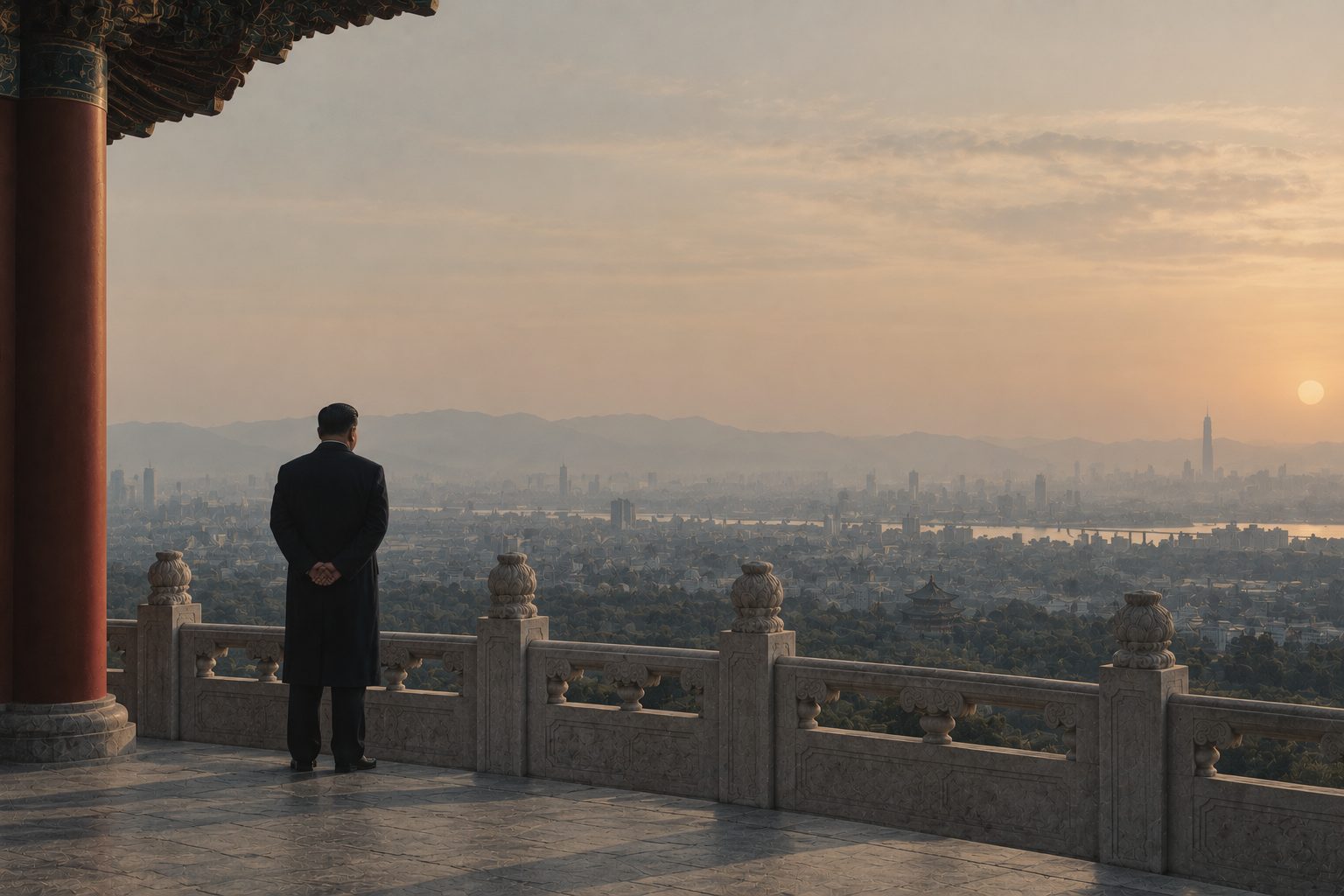
Xi Jinping and the machinery of power
On China V - The Politics of Control
Who is Xi Jinping? Hard to say. He is, of course, the general secretary of the Chinese Communist Party (CCP). He is the chairman of the commission that commands the People’s Liberation Army (PLA). And he is, as almost everyone now grants, the most powerful man in modern Chinese history outside of Mao Zedong.
But who is Xi Jinping? He is the son of a founding revolutionary. He was, once, a boy that same revolution exiled to a cave in Shaanxi for six years. Prior to his accession to the general secretaryship of the CCP, most would have said he was Peng Liyuan’s husband, her fame as one of China’s preeminent folk singers far surpassing his. He is a father, but not yet a grandfather. He is, apparently, an avid swimmer.
He is also a man in complete control of the nation he leads, a man who has dismantled every guardrail China’s reform era erected against personal rule following Mao’s death. It is therefore tempting to explain him as the latest in a line of CCP strongmen, a successor to Mao or Deng. But this explanation risks mistaking the man and his place in history. When all is said and done, we will likely place Xi in the company of the great historical consolidators, the men who unified fractured and contested realms and bent them ruthlessly towards their aims. Think of Augustus. Think of Qin Shi Huang. Think of Genghis Khan. Think of Xi Jinping.
If those names feel too strong, consider what Xi actually holds. China is a nation of 1.4 billion people, a number that for most of recorded history would have exceeded the population of the entire planet. China’s manufacturing base is the largest humanity has ever constructed, an industrial machine that can produce essentially anything, at any scale, faster and cheaper than any rival. China’s surveillance apparatus is the most comprehensive instrument of human observation ever built. And China’s military, three decades into an uninterrupted expansion, is now the unquestioned land power in Asia with a nuclear arsenal large enough to end organized human life.
Xi commands all of it. Few individuals in the history of the world have held this much power, and fewer still have arrived at it the way he has; late, deliberately, after a long climb that most of the world mistook as ordinary politics. His campaign to consolidate his control has only recently achieved its objectives. He may not be a young man, but he is a new one, unbounded for the first time, all the power of China resting in his hands alone. To understand what he will do with it, start where he started.
Who is Xi Jinping? He was born in 1953, into the aristocracy of the CCP. His father, Xi Zhongxun, was one of the CCP’s founders, a guerrilla commander who had built a base in China’s northwest when the communists were still hunted men. The elder Xi rose after the communist victory over the nationalists in 1949 to the position of vice premier. His son grew up inside the walled compounds of the new Chinese elite, in the schools kept for the children of the men who now ran the country. His was a childhood at the center of things, proximate to Mao himself, the sort of childhood that allows a boy to inherit a nation instead of simply making his way in it.
But Xi’s childhood did not hold. In 1962, when Xi was nine, his father fell from power, the victim of an arbitrary political purge that served as a prelude to the Cultural Revolution. Xi Zhongxun’s “crime” was being caught up in a political case surrounding a novel about one of his old revolutionary comrades, which his enemies recast as an attempt to revive a rival revolutionary faction. Xi Zhongxun was an ardent communist, dedicated to China and dedicated to the party. He was eventually rehabilitated and restored to political life, the charges against him effectively erased by the same system that had imposed them. But these facts did nothing to save him in 1962.
His descent lasted the better part of two decades. He was expelled from the party he had helped build, set to hard labor in a factory, paraded before crowds, and denounced in one city after another. At one point he was publicly beaten so badly he permanently lost the ability to hear out of one of his ears. He was imprisoned for years, separated from his family, his health broken, his name a curse.
This was a common enough story in 1960s China. Within the closed rooms of authoritarianism, the purged official dragged from the summit to the factory floor or a prison is ordinary furniture. What such stories tend to omit, however, is that state persecution rarely stops at the man. It extends to the family, guilty by association, and the purged man’s children inherit his disgrace.
This was the case for Xi Jinping, who, at age thirteen, was hauled before jeering crowds where he was forced to denounce his father. He was locked up more than once. By his own account, he collapsed from sickness in detention and thought of dying. He often went hungry, the family dispersed, his mother sent away to a labor camp of her own, the apparatus of an elite childhood dismantled around him. One of his half-sisters, Xi Heping, did not survive the period. It has been reported that she hanged herself under the weight of the persecutions inflicted on her family, though this has never been officially confirmed.
We cannot know for certain what those years did to Xi Jinping, or what he made of events as they took place. The record of his childhood is thin, and much of what survives is clouded by later mythmaking. What we do know is that in 1969, at fifteen, he, along with millions of other urban youths, was sent out across China’s countryside to be re-educated and hardened by rural labor in the way Mao imagined soft city children needed hardening. Xi was sent to Liangjiahe, a village in the parched hill country of northern Shaanxi where the yellow loess soil runs to dust and the rains do not come when they are wanted.
The village itself was among the poorest in a poor province, a scatter of cave dwellings dug into the ravines of the Loess Plateau. There was no electricity and no machinery. Meat was a thing that came a few times a year. In the lean months, after the spring festival, much of the village emptied out, the farmers going off to beg on the roads until the next harvest came in. There isn’t much else to say about this place. Liangjiahe was destitute in the way that admits no redeeming description. It was hunger and dust and labor and nothing else.
Xi lived there in a cave dug into the hillside, sharing it with the other Beijing youths who had been sent down alongside him, six children of the capital sleeping in a dirt room at the edge of nowhere. And there he labored. He carried buckets of “night soil”, human waste used as fertilizer, and hauled coal, and worked the thin fields. He slept on a kang, the raised earthen platform that serves as a bed in that part of China, and the fleas in his bedding were so relentless that he took to dusting the mat with DDT powder each night and woke with bites and sores across his skin regardless.
In the evenings, by the light of a kerosene lamp, he read the books he’d brought with him from Beijing. Much of what he read was the literature of the revolution that had cast his family down, the classics of Marxism and the novels of the Bolshevik imagination. His favorites included the story of Rakhmetov, the young Soviet revolutionary who sleeps on a bed of nails and forgoes every comfort to make himself equal to the cause of communism. He read the doctrine of common ownership and shared property. And the books themselves were his, and he kept them as his, and the others in the cave learned not to touch them.
He watched half a dozen birthdays pass in this place, no electric light, no horizon to illuminate. He ran once, back toward Beijing, and was caught, and was sent back to dig ditches, and never ran again.
There was only one way out of Liangjiahe, and that was up. Everything, a recommendation, an education, any return to the world Xi had been torn out of, ran through the party, the same party that had purged his family. So, he applied, again and again, for membership to the party, and was refused on numerous occasions, the disgrace of his father hanging over each rejection. The accounts differ on how many times he applied for admission. The number most often given is eight.
What is not in dispute is that he kept at it, through refusal after refusal, until, at last, an application was accepted. He was made party secretary of his village, a position that would, in time, carry him out of Liangjiahe, to a university in Beijing, and back into the world.
Who is Xi Jinping? The West has spent a decade trying to decide between two terms. Is he a pragmatist or a Marxist? Is he Deng or is he Mao? The question is asked as though the answer were out there to be found, as though the man contained a settled truth that better analysis will eventually reach. It is worth noticing how badly the west wants him to be a pragmatist, because a pragmatist is a man who can be bargained with, who will, when the price of conviction climbs high enough, do the sensible thing.
Run the question through Xi’s early life and the pragmatist reading is easy to build. A boy watches a state turn on its own and devour them, watches his family scatter, watches his father dragged through the square, and draws the only lessons the scene permits. In this system, to be without power is to be at anyone’s mercy. Security lies in control, and control is never to be surrendered.
Everything Xi has done since, the accumulation of control, the purges he has himself unleashed, the refusal to let any center of power stand outside his own, follows from that lesson. This reading is true. It explains a great deal, and it asks nothing of the reader that the reader does not already understand.
But consider what a person actually does when the group that is the source of his identity casts him out. He does not, as a rule, walk away and build a self apart from the group. He strives to get back in. He works to prove his worth to the very body that rejected him, and in the working, he tends to internalize its faith more completely than those who never had to fight for membership.
This is the ordinary shape of exile, visible in churches and parties and families the world over. The exile buys their return in the only currency the group accepts, a faith performed so relentlessly that it becomes indistinguishable from genuine belief.
Did the boy apply eight times to join the national faith despite holding it in contempt for what it did to his family? Did he apply eight times because he simply needed a position in the party, ambivalent to what the party professed? Or, somewhere in that cave, in the labor, and the slow climb back toward warmth, did Xi Jinping become a true believer, a genuine Marxist? Did the performance of faith become indistinguishable from belief to Xi himself?
Here the Western question begins to come apart in the hand. It was built to sort him, the pragmatist into one box and the Marxist into the other. The trouble is that the west cannot imagine a Marxist who is simultaneously a competent pragmatist, because in its own tradition the two are opposites. The pragmatist is the one who sets the doctrine aside to deal with the world as it is. The ideologue is the one who breaks the world against the doctrine.
A serious Marxist, in this picture, is a man whose convictions must eventually make him foolish, and Xi has yet to be foolish, so his Marxism is often assumed to be a costume. But that is an inference from the West’s categories, not an observation of Xi. It assumes the belief and the calculation must pull against each other, that a man who is shrewd cannot also be devout.
But perhaps, in Xi, they pull together. Perhaps the shrewdness serves the conviction, and the conviction directs the shrewdness. We cannot see inside him to know. But we do not need to. The two readings the West cannot hold at once, the operator securing his own power and the Marxist serving the arc of history can converge. Whichever one is true, or if both are, or if the distinction was never real, the conclusion is the same. Xi does not let go of control. You do not need to solve him to understand that.
Who is Xi Jinping? Perhaps the answer exists in the mechanics of his rise and consolidation. His climb was long and unglamourous. After the cave and a university degree from Tsinghua, Xi spent three decades as a provincial administrator. He was first appointed to a role in Hebei, then a long stretch in Fujian that carried him to the governorship, then the top party post in Zhejiang, and finally, in 2007, the same job in Shanghai, a city reeling from a corruption scandal. Xi steadied the city without drama, and this is what made his name. He had a unique ability to handle corruption quietly, ensuring its stench never contaminated the image of the party.
Within months of his posting to Shanghai, he was lifted onto the Politburo Standing Committee, the small body at the summit of the CCP. A year later, he was made vice president and was understood by everyone to be the man who would eventually replace Hu Jintao as general secretary, the top position in Chinese political life.
He got there without ever quite declaring himself. He was cautious where others were vivid, always loyal to the party line, and difficult to place on any factional map. Both of the great camps that divided the CCP, the coastal, pro-business “Shanghai Gang” and the populist, inland Tuanpai faction, could look at Xi Jinping and see someone they could live with. He was a compromise, a safe pair of hands, a man whose chief qualification was that no one found him threatening.
By 2012, Xi was on the cusp of becoming the most powerful man in China, but the office he was set to inherit sat atop a Politburo thick with men who had built their own power bases, their own patronage networks, their own fortunes, and who could constrain a general secretary, even if none could replace him. The most formidable was Bo Xilai.
A princeling like Xi, the son of a revolutionary elder, Bo was everything Xi was not, magnetic, theatrical, and openly ambitious. As the party boss of Chongqing, he had built a personal following cultivated through populist campaigns, a revival of Maoist songs and slogans, and a public war on organized crime. He did not have the power to actually unseat Xi, but he did represent a rival center of gravity, a demonstration that a Chinese leader could still build a mass following of his own outside the grey waters of party-consensus that Xi preferred.
But months before Xi’s succession to the general secretaryship, Bo’s career imploded in scandal. His wife, Gu Kailai, had been using a British financier named Neil Heywood to move the family’s money out of China and into safe havens abroad for years. This was ordinary, the thing families at the top of the party did with the fortunes they were not supposed to have. What was not ordinary was that the arrangement broke.
Heywood, seeing the scale of what he was moving, demanded a larger cut, and when Gu refused, he threatened to expose her. Fearing revelation, she had him poisoned in his hotel room in Chongqing.
The murder might have stayed buried had Bo’s own police chief not investigated it, brought damning evidence to Bo, and found himself demoted and endangered for his trouble. Fearing for his life, he fled to the American consulate in Chengdu and told the Americans everything he knew.
Within days, the foreign press was reporting on the incident beyond the reach of Chinese censors. From there, it seeped back into China, across a Chinese internet that in 2012 was still porous in places.
It spread on Weibo faster than the censors could delete it, the speed of its spread a measure of how much public fury the party’s open corruption had generated. Before long the CCP had no choice but to acknowledge the affair. It stage managed a public prosecution of Bo and his wife, who were both sentenced to life in prison.
Bo’s fall could not have been better timed for Xi. It handed him a mandate on the eve of his accession to the general secretaryship, one that he would exploit with aggressive precision. The scandal had confirmed what everyone already knew; that graft had become the operating system of the CCP, and that if left unchecked, it could become the kind of rot that could dissolve a party from within. Rooting it out became the one cause in Chinese politics that no one could oppose and rooting out corruption happened to be the very thing Xi had built his name on.
But a war on corruption in a party where everyone was corrupt is a strange kind of crusade. If everyone is guilty, the only question is who gets charged. That decision became Xi’s, the mandate to prosecute arriving almost exactly with his elevation to the general secretaryship.
Xi’s next moves demonstrate a pattern. The anti-corruption campaign he launched, in its early years, swept up men who belonged, again and again, to the networks that might have checked his power while officials who could demonstrate loyalty to Xi were left, for the most part, untouched.
He began at the top. Across his career Zhou Yongkang had built one of the great power structures of the modern CCP, spanning three domains that could each, on its own, anchor a political career. He had run Sichuan, one of China’s largest provinces, and staffed its government with his men. He had risen over three decades through the state oil industry to run the China National Petroleum Corporation (CNPC). And in his later career he had commanded the entire apparatus of state security including the police, the courts, and the intelligence services. A province, a strategic industry, and the coercive organs of the state, all of it answering, through a chain of favor and dependence, to one man.
By the time the anti-corruption campaign reached him in 2014, Zhou had retired from the Politburo Standing Committee, whose members had always been understood to be beyond prosecution. What made him vulnerable was not any single weakness but a convergence of man and moment.
Zhou was corrupt, but so was everyone. His corruption only became fatal because it met a political environment that had turned corruption into the party’s defining emergency, and a rising leader with the standing to act on it. And the charge Xi levied against him was not merely graft. Zhou was cast as a plotter, tied to Bo Xilai in what the party framed as a “conspiracy” against itself (i.e. a coup).
Once the head of the network was marked in those terms, the whole body became fair game. Zhou’s network didn’t rally to support him after his arrest because most of them were busy being arrested themselves. Each one’s political survival turned on proving how little they owed to Zhou, which was best accomplished by supplying the state with evidence against others in the network.
Working down from the fallen patron, the campaign took them in their hundreds, the Sichuan officials, the oil executives, and the security men, three entire power bases destroyed. Zhou was given life in prison, the first Standing Committee member to ever receive such a sentence, which was a norm Xi was all too happy to break.
Zhou was the largest but not the only one. The same operation ran through the party’s other great machines. Ling Jihua, chief of staff to Xi’s predecessor, was dismantled the same way, his network pulled apart around him, replaced by Xi loyalists. Others followed until the pattern had done its work and no longer needed repeating.
The product of this work was a defeated party. The men who still ran their own networks now understood what had happened to those who thought their rank protected them. They were corrupt, as everyone was, which meant the evidence to end them already existed somewhere, waiting in a file. Whether it was ever opened depended on whether they displeased Xi which meant, year by year, prosecution after prosecution, the party bent toward Xi’s will and Xi’s will alone.
But the campaign did not stop at the party. It reached the army, which in China is not a national force, but the armed wing of the CCP itself, sworn to the Party and not the state. Mao’s rule was that the Party must command the gun so that the gun does not command the party, and Xi, increasingly, was becoming the Party.
The corruption within the PLA was flagrant. Under Xi’s predecessor, the two vice chairmen of the Central Military Commission had run the promotion system as a market, ranks and commands sold for cash, a general’s stars a matter of what he had paid. Xi took them both, prosecuted them, and worked downward through the networks beneath them exactly as he had in the party, hollowing out the senior ranks and refilling them with loyalists.
But with the army, he went a step further. He rebuilt the entire structure of the PLA. He broke apart the general departments and regional commands where military power had pooled outside his reach and reorganized the whole structure so that authority ran through him alone and no rival center could form again.
Military purges continue to this day, reaching even the men Xi himself elevated, including officers who command China’s nuclear arsenal. He does this because an army under permanent investigation is an army that can never cohere into a power of its own. The repeated purge prevents any figure or faction within the PLA from developing the kind of power base that would allow for autonomous action and therefore threaten Xi’s control.
Who is Xi Jinping? By the time the work was finished he had become something the reform era had built its every guardrail against, a single man holding the whole of the party, the state, and the gun. His rivals were gone or subdued, his thought was written into the constitutions beside Mao’s, and the term limits that were meant to prevent exactly this kind of centralization were removed at his insistence.
It is possible to see in all of it nothing but the oldest story there is, a man who wanted power and took it. But that reading has to ignore how precisely he’s followed a certain script.
Leninism has always held that history is driven by a vanguard, that the vanguard is the party, and that the party’s grip on power must be total, unshared, and defended without sentiment. Concentrate all authority in the party. Concentrate the party in its core. Permit no rival center, no autonomous general, no economic giants outside the party, because divided power is power leaking away from the task history has assigned to the vanguard.
Xi did each of these things. The doctrine tells him to seize everything. Seizing everything is what he wants anyway. In Xi Jinping the appetite and the theory point at the same act, and they always have.
Who is Xi Jinping? There is one more clue, one that deepens the question rather than resolving it cleanly. It is tempting to call it economic, and it is economic, but the word is another frame that closes in on you the moment you raise it, allowing the object of attention to slip away once again.
It is better described as the machinery by which a single hand decides where China’s wealth flows, and therefore who prospers and who is left to fail, and therefore how a billion people save, spend, and behave, and therefore which firms rise and which are quietly strangled, and therefore what leverage China holds over a world that has grown to depend on it.
Follow the machinery in any direction and it keeps turning into something else, economic into social into political into strategic and back into economic until you understand that these were never separate things, only a single instrument seen from different sides. Xi built that instrument or inherited it and made it his own. It is the one thing he holds that he cannot put down.
Economics with Chinese Characteristics
In November 2020, Ant Group was days away from listing on the stock exchanges of Shanghai and Hong Kong in what was expected to be the largest initial public offering in the history of the world. The sale was expected to raise $34 billion and to value the company north of $300 billion.
Ant Group was the financial arm of the empire Jack Ma had built; the payments network that hundreds of millions of Chinese used to buy their groceries and pay their rent and lend and borrow at the tap of a phone.
Ma himself was the closest thing China had to a folk hero of private enterprise, the former English teacher who had become the richest man in the country. But days before the IPO was scheduled, the listing was suspended. Chinese regulators summoned Ma to a meeting. The offering was canceled, and Ma, who weeks earlier had stood before a conference of officials and likened China’s state banks to “pawnshops” went silent, and then largely vanished from public life for the better part of a year.
To the watching west, the story wrote itself. An outspoken billionaire had criticized the Party in public, and the Party had made him disappear. It was read as a parable of authoritarian control, of what happens to a man who says too much in a country that permits too little.
A year later, in the autumn of 2021, a different kind of story began to surface, this one about a company almost no one outside of China had heard of. Evergrande was one of the largest property developers on earth, and it was running out of money. It had borrowed on a massive scale, to the tune of some $300 billion that it owed to banks, suppliers, and ordinary Chinese families who had put their savings down on apartments that had not yet been built. In September 2021 it began missing payments. By December it had defaulted.
For a Western financial press with a particular memory, the reference point was immediate. This was China’s Lehman Brothers, its subprime moment, the overleveraged giant whose fall might bring the financial system down with it. The coverage tracked the contagion with anxious attention. Would Evergrande’s default spread to the global markets that had grown used to Chinese growth as a fixed feature of the world? Analysts watched for the cascade the way they had watched in 2008, waiting to see how far the damage would run.
What did these two moments have in common? On the surface, not much. One was a tech tycoon silenced, the other a property giant drowning in debt. But look again. Both were episodes of staggering financial destruction. Ant’s cancelled IPO erased hundreds of billions in value from what had been the most anticipated public offering in history. Evergrande’s collapse was larger still, and it did not stay contained to one firm. It spread through the property sector that held the bulk of Chinese household wealth, and the losses that followed, still accumulating, run into the trillions.
And they both happened in the same narrow window, between late 2020 and end of 2021, a span of little more than a year. It was, as it happened, a particular window. In 2018, Xi had erased term limits for himself, the last constraint on his power. And 2020 was the year the pandemic handed the state a season of emergency rule, when it could impose enormous cost on its people and meet no resistance. The two largest financial collapses in CCP history, in other words, arrived in the first stretch of time in which a fully unconstrained Xi existed.
Finally, both events were misread in the same way by those watching from the outside. Ma’s fall became a story about free speech, Evergrande’s about financial contagion. But strip away the differences in form and interpretation, and you realize that each event was the same thing.
Both firms acted as a channel through which the savings of the Chinese people could be allocated by someone other than the state. That is the whole of the offense, and to see why it is an offense at all, why it is, in fact, the one offense the CCP, with Xi at its head, cannot survive, you have to understand what the savings of the Chinese people are, and what becomes of them once the state has them in hand.
Power
The most powerful facts about money are usually the plainest, which is why they are so often missed. We are forever calculating what money can do and rarely stop to ask what money is. But slow down and ask the question. Watch as your conception of money dissolves into a set of facts with an older kind of power, facts that transform one thing into another, and facts that fix the boundaries of what can be. There are many such facts. Here are two:
First, money that is saved is the same thing as money that is invested. Savings, the moment they are saved, are gathered up by the machinery of finance where they are, almost instantaneously, lent out and put to work. This is the closest thing to alchemy our modern world has. A nation’s financial system imbues its will into what the nation has saved, and the savings are transformed into the things that will stand tomorrow. Savings are a nation’s future in its raw form, the monetary precondition of material instantiation, seen a moment before the building begins. To save is to reach for the future, to invest is to give that reach shape. Different words, same substance, same goal.
The second is that consumption is the opposite of saving and therefore the opposite of investment. To consume is to spend, here and now, in the present. It is the using of potential, the discharge of value, the transformation of capacity into a meal, a journey, or some form of comfort that cannot then be turned toward the future. It is an act of a certain kind of sovereignty. When you consume, you keep for yourself what the system would otherwise have taken and put to its own uses. The unit of value that becomes your meal is a unit the machinery of finance does not get to hold, does not get to lend, and does not get to direct. To consume is to reach into the common store of the future and pull out a portion of your share. To consume is to spend on a present that is yours alone.
Now take these two facts and set them down in China. This series of essays has gone to great lengths to show how the Chinese state suppresses the ability of its own households to consume. What cannot be consumed must be saved.
This series of essays has also gone to great lengths to show how the Chinese state ensures savings can only pool in one location, the state-owned banking system. Chinese citizens cannot meaningfully invest abroad; their capital account is closed. Chinese citizens cannot meaningfully invest in their stock market; it is too volatile a place to put one’s life savings. And now, with the destruction of Evergrande and the entire property market as a whole, Chinese citizens cannot meaningfully invest in property. Strip away the object of each preposition and what are you left with? Chinese citizens cannot meaningfully invest. They can only save.
But are these not the same thing, saving and investment? Yes, they are. And that is the whole of it. The Chinese household performs one half of a single act and is forbidden from the other. It saves, which to say, it reaches toward the future. But it may not invest, it may not give the reach a shape, it may not say what its own savings will become. The second half, the shaping, the deciding, the turning of latent money into physical reality, is a power the state reserves for itself. But what is this power? How does it operate? Through transfiguration.
The savings of the household, in the instant they enter the state’s bank, are transfigured. They enter as the savings of a billion citizens and come out as the will of the state, as the power to build a city, the power to finance a firm, the power to create a fortune. But this power is not unidirectional. It does not only create.
The power to build a city is also the power to leave a city unbuilt. The power to finance a firm is also the power to strangle one. The power to create a fortune is also the power to erase it. The people save. The state invests. And the distance between those two verbs, which any economics textbook will tell you does not exist, is the whole of Chinese power. It is a kind of power the West no longer has a word for, not just the power to govern an economy but the power to author the conditions of existence.
Begin at the smallest scale, with a single person. In China there is one surface on which an economic life is conducted. All transactions move across payment rails controlled, either explicitly or implicitly, by the state, and there is no alternative. This is difficult for a Western reader to feel, because a Western life is lived across many surfaces at once. There are a dozen banks that would take your deposit, there is usually a second card if the first is declined, there is cash underneath it all. To be shut out of one surface, in the west, is merely to step onto another. In China, there is no other. The surface is singular, and the surface is the state.
This means that the state could bar any citizen from its payment platforms, and that citizen would effectively be shut out from economic life. But the state does not have to freeze a man’s accounts or lift him off the payment system to achieve its objective. It only needs the capacity to do so. The capacity is the instrument, and the instrument does its finest work held in reserve. This is what it means to walk on thin ice. A man who understands that the ground can be withdrawn from beneath him arranges his steps very carefully.
Now widen the lens to the firm. In the West, a company that has found a product and a market can grow on its own, funded by profits, by investors, by banks competing to lend to it. The state, in other words, provides a set of rules, but does not, normally, provide funding. In China, no enterprise reaches meaningful scale this way. The capital that feeds growth flows from the banks the state owns, on terms the state sets, towards the ends the state favors. When a firm is permitted to grow, it is fed.
But what can be fed can be starved. This is the point that matters, the inverse of the point the West tends to notice. The West sees the subsidy, the cheap loan, the favored champion showered with capital and reads a story about state support. The truer story is on the other side of the ledger. A firm that lives on state capital also lives under the standing threat of its withdrawal, the quiet closing of the tap that every large Chinese company drinks from.
No firm that depends on that flow can afford to be on the wrong side of Xi. Controlling the flow of capital to the nation’s enterprises gives the state enormous capacity to discipline firms. As a result, the founder who might have grown troublesome or the company that might have accumulated a power of its own orders itself around the preferences of the state long before the state has to say a word. Both the founder and the firm understand, as everyone in China understands, what happens when the capital is withdrawn.
This is what Jack Ma had discovered, and what Ant Group was truly punished for. It had begun to feed itself, and worse, to feed others, to become a source of capital in its own right, a second hand reaching towards this lever of near ultimate power. That could not stand. Chinese firms may grow as large as the state allows them to. They may not grow large enough to feed themselves because a firm that feeds itself is a firm the state can’t starve.
Now widen the lens as far as it goes, past the individual and the firm, past the borders of China itself, to the world. The same lever that disciplines the Chinese saver and the Chinese firm reaches into every economy that interacts with Chinese industry, which is, essentially, every economy on earth.
Recall what the export machine does. It suppresses domestic consumption, captures the savings that suppression produces, and directs that vast pool of capital into productive capacity at a scale that is unprecedented in human history. A country that builds this much and consumes this little makes far more than it can use. The surplus has to go somewhere, so it goes outward, into the world, as a flood of goods priced below what any competitor lacking this level of state support could match. The lever that disciplines a billion people at home is, in short, the lever that floods the world with exports.
And in an open trading order, a flood of goods priced that low hollows out every industry it touches, in one country after another, until the capacity to make certain things exists in China and nowhere else. The processing of rare earths that modern industry cannot function without, to take only the sharpest example, now sits so overwhelmingly in Chinese hands that the rest of the world manufactures only at China’s sufferance.
Strip out China’s dominance of that single chokepoint and the entire conversation about China’s power reads differently. The export machine, in other words, is a deliberate foreign policy choice. China exports its surplus below any price a rival industry could survive and waits. The competitor’s factories, faced with an onslaught of cheap Chinese goods, close. And once the factories are gone China is able to exert its influence. It can withhold critical goods, goods no nation can survive without, in the event it requires a concession, be it economic, diplomatic, or territorial. But again, China does not have to use this power for other nations to feel it. The threat is enough. That is leverage. That is power.
Now stand back and see the whole of it. One mechanism, running from the smallest scale to the largest. It decides whether a single person can buy a train ticket, and whether a firm employing thousands lives or dies, and which of the world’s industries survive and which become dependent on China. The lever that reaches into a man’s morning commute simultaneously reaches into the trade of continents, because it is the same lever, and there is only one.
This is what it means to hold the flow of a nation’s capital, whole and undivided, in a single hand. You cannot call it an instrument of power, not at this scale. You must call it power itself, the axis around which all other forms of power orbit. And it is why the question that hangs over the whole of China’s future, the question of whether it can rebalance its economy and so relieve the existential pressure that China’s export machine places on the very trade order it’s continued existence relies on, is not really an economic question at all. It is a question about power, and it answers itself.
To rebalance is to let the household consume, to spend what it could have saved, to decide where value is instantiated in China. It is to return the sovereign act to the individual; to open an exit the state has spent decades closing, to allow a hundred million pins to prick the pool of capital the state has gathered in one place.
Recall what the savings are. Not idle money, but investment, the future in its raw form. They are the wellspring of domestic control, the export flood, and the leverage over nations. To hand those savings back to the people, to allow the savings to be consumed, is to break the single lever of Chinese power into hundreds of millions of pieces and to give one piece to each citizen.
Consumption is the opposite of saving. Every yuan returned to the household to spend is a yuan the state can no longer direct, a fraction of the future removed from the state’s hand, a small piece of the lever surrendered. Rebalancing is not some economic reform the state has been slow to enact. It is the one thing the state cannot do and remain the thing it is.
Return to Ant Group and Evergrande, because we can now see what they were, which was primarily demonstrations of Xi’s power and Xi’s intent. They were the missing clues that help us answer the question, who is Xi Jinping?
Recall what was destroyed. Ant Group was the most valuable financial company on earth on the eve of its listing. The property sector was the store of savings of the Chinese middle class, the largest asset most families would ever hold, accumulated across a generation.
In breaking both of them, the state presided over the destruction of household wealth on a scale that has few equals in the history of the world outside of war, a sum that is still being counted, but runs, easily, into the trillions. Xi did this deliberately, understanding what would follow, and proceeded anyway.
Set that beside the ordinary calculus of governments, which will bend almost any principle to avoid destroying the savings of their own people, and the magnitude of the thing comes into view. This was, very likely, the largest deliberate destruction of wealth ever undertaken by a state at peace. And it was undertaken to recover control that had, at the margins, begun to slip.
That is the answer to who is Xi Jinping. It is the answer for anyone who imagines the pressures now bearing down on China will force it, in the end, to rebalance, to loosen its grip, to let its people consume and so relieve the strain that each essay in this series has traced. A man that will destroy that much wealth to reclaim the small fraction of the lever that had slipped away is not a man that will surrender the lever again. He has shown, in the plainest terms available to him, that he will pay any price to keep the lever for himself.
China will not rebalance. It will tighten its grip on its citizens’ savings, push still more of the nation’s capital through channels it controls, lean harder on the export machine as international pressure mounts, and call the tightening strength. This is the trap this whole series has been circling. The same mechanism that gives Xi his power is the same mechanism that creates his greatest fragility.
You cannot suppress the consumption of a billion people, capture their savings, and funnel them into industrial capacity without building an industrial base scaled to a level of demand that, by design, does not exist at home. You cannot then run that industrial base without flooding the world with your excess goods. And you cannot flood the world with your excess goods in perpetuity. Eventually the world will start resisting. Eventually tariff walls go up. Eventually protectionism becomes the prevailing sentiment, not just in America, and not just under Trump, but of the world, of the countless nations who cannot allow their remaining industries to be overtaken by a China that refuses to consume what it makes.
This resistance has already begun. It is still partial, still uneven, but the direction is unmistakable. Huawei was shut out of Western networks on security grounds, not to protect domestic industries, but it was shut out. The EU imposed anti-subsidy duties on Chinese EVs in 2024. The United States and Canada went further, imposing fifty- and one-hundred percent blanket tariffs on those same vehicles. Turkey followed suit. Mexico imposed protectionist measures on Chinese goods ranging from steel to zippers to hydraulic jacks. South Africa moved to protect its solar manufacturers. Brazil, India, Indonesia, Thailand, Vietnam, Malaysia, Chile, Colombia, and Peru have all raised barriers of their own, most of them against Chinese steel, but the categories of goods grow larger every year.
China now produces roughly thirty percent of the world’s manufactured goods. A UNIDO report published in 2024 projects China’s share of the global industrial production could approach forty-five percent as early as 2030. No nation has ever produced this fraction of global output while consuming so little. There is no precedent for this imbalance, and therefore no precedent for what happens when it begins to unwind, when nations begin to resist the flood. There is no mental model, no way to think through all the myriad ramifications of a significant, medium-term contraction in Chinese export volumes.
And there will be a contraction. Importing nations will refuse the flood, or America will refuse to uphold the order that makes the flood possible, or both will happen simultaneously. The contraction will almost certainly occur before the west has built enough industrial capacity to come close to replacing the export volumes China sends out into the world.
And even if America, and its allies, industrialize in time, we will never produce goods as cheaply as China, and we will never exist in a capital environment capable of propping up asset values and American consumption to the degree we witnessed during the height of the imbalance. The unmanaged unwinding is the first step towards the first genuine crisis the world built after 1945 will face.
Washington has not begun to seriously model this. American strategic imagination remains fixed on a China that expands, projects, coerces, then overtakes. But, as this series of essays has shown, the more likely scenario is a China that contracts, that fragments, that implodes under the weight of its cascading structural fragilities. Reorientation toward that reality was the purpose of this series. The desire is not to end a conversation, but to begin one. How do we prepare for this future?
This series isn’t built to answer that question. The absence of rebalancing, and the unwinding that absence guarantees, is the great geopolitical challenge of the coming era. It will not resolve cleanly. It will not offer the kind of answers that fit inside a single administration or a single strategy document. This is the beginning of something that will demand sustained attention for decades, something that will test the capacity of every institution built to manage the last order, something that will force the construction of the new order to come.
There is a temptation to receive this as misfortune, the burden of living at the moment the arrangement comes apart. It is the opposite. The generations that built the postwar order did not choose their assignment either; they were handed a ruined world and asked to make something durable from it, and they did. We are being handed a subtler task, to unwind an order that is ending without letting its ending become a catastrophe, and to build the order that follows with the benefit of knowing how the last one failed.
This is the rarest kind of opportunity, the chance to design rather than inherit. Few generations get to decide what the world will be. This one will. We only need to decide if we will do so deliberately, with eyes open, or blindly, after the fact, cleaning up a wreck we refused to see coming. Reorientation is how we choose the first path over the second. The choice is still ours. It will not remain so for long.