American strategy and the cost of incoherence
On Industrial Gravity
In 2024, on a 200-acre site in Seadrift, Texas, a coastal town of roughly 1,300 people on the Gulf of Mexico, Lynas Rare Earths began preparing ground for what the Department of Defense had spent years trying to will into existence. The facility was meant to process heavy rare earth elements, the materials embedded in the guidance systems of F-35 fighters, in the motors of electric vehicles, and in the permanent magnets inside generators that convert wind into electricity. The Pentagon had committed $288 million to the project across several contracts, invoking the Defense Production Act and the language of national security. The target was clear on paper: rare earth separation capacity on American soil, outside the orbit of Chinese industry, which processes somewhere between eighty and ninety percent of the world’s supply. The facility was scheduled to begin production in early 2025.
By late 2025, Lynas’s CEO was telling investors the project likely wouldn’t proceed. Engineering reviews had identified unexpected clay deposits in the soil requiring additional foundation work. Front-end design ran into filtration requirements no one had budgeted for. Offtake negotiations with the DoD stalled. And beneath all of it, prior to the delays and the cost overruns, was a simpler problem. The wastewater generated by rare earth separation contains lanthanides and radioactive residues requiring specialized treatment. Lynas had a plan for this; discharge through an existing treatment system at a nearby Dow Chemical plant. This would have required Texas regulators to amend Dow’s wastewater permit to dramatically expand its discharge capacity. A local environmental activist who had spent decades fighting Dow’s pollution in Seadrift challenged the amendment. Ultimately the costs of litigation for Dow outweighed the benefits. They withdrew the amendment, and the plan collapsed.
Within fifty miles of Seadrift, there are fourteen industrial wastewater facilities. As it turned out, none had the capacity, the permits, or the community history that rare earth processing would require. That capacity, so it seemed, only existed in Southeast Asia, where Lynas had been operating since 2014 inside an industrial and regulatory ecosystem built around exactly this kind of work. Ultimately, the Trump administration was forced to pull the funding, and the project died.
What failed here was not ambition, nor a lack of funding. $288 million is not a rounding error. What failed was the assumption; that capital, applied with sufficient urgency to a problem sufficiently declared a national priority, could compress the distance between where industrial capacity is and where a government needs it to be. That assumption runs through nearly every supply chain resilience document produced in Washington over the past decade. It is worth examining carefully, because the assumption is wrong. Industrial capacity is not a deficit to be funded. It is a structure to be built.
Industrial Gravity
Watch any industry long enough and the same thing tends to happen. It concentrates. A semiconductor fabrication plant is never alone for long. Suppliers of ultra-pure chemicals find it, then manufacturers of precision components, then engineers trained on its specific equipment, lawyers fluent in its regulatory environment, logisticians shaped by its supply rhythms. Each addition makes the next addition more likely. The cluster thickens. Over time, what begins as a collection of proximate, but uncoordinated, firms becomes something harder to name and harder to move; a body of accumulated practice, embedded in specific people, specific infrastructure, and specific institutional relationships that take decades to form and cannot be reassembled elsewhere by writing a sufficiently large check.
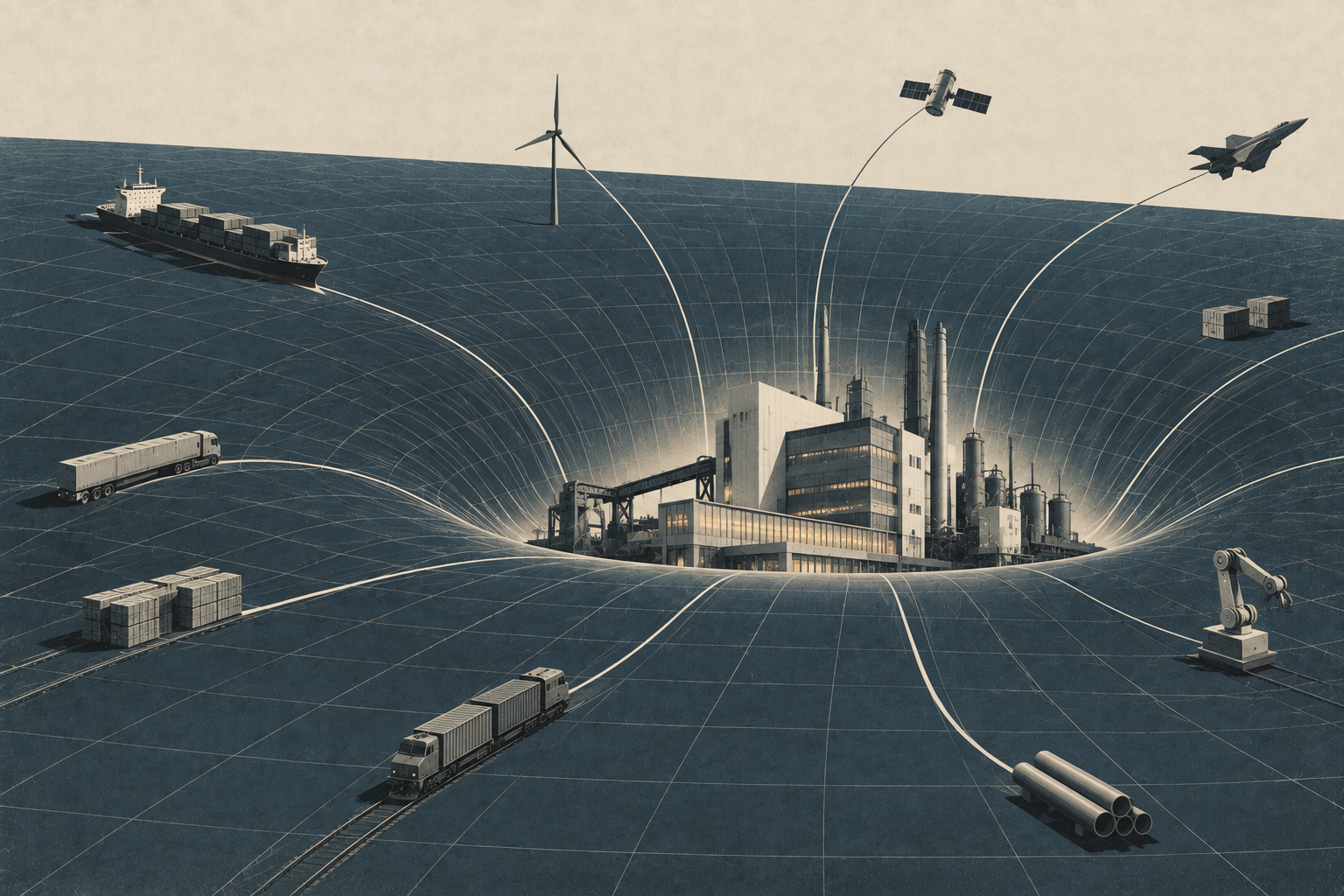
This is industrial gravity. Not a metaphor, exactly, but a description of how industrial production systems actually behave over time. Gravity, in the physical sense, pulls mass toward mass. Industrial gravity pulls capacity toward capacity. Planned industrial infrastructure is drawn toward existing industrial infrastructure, settling where the roads, the regulators, and skilled labor have already accumulated. Capital is attracted to ecosystems that already provide steady returns because the risk of competing with accumulated mass is rarely worth bearing. Skilled workers orbit industrial centers where their labor is fully understood, fully utilized, and compounds in value with every year spent inside the ecosystem. This is not how software works, or finance, or most of the service economy that the United States has built its prosperity around for the past forty years. A startup needs a laptop and a good idea. A software team can be assembled across continents and reassembled elsewhere without losing much. Capital in those sectors bets on emergence, on markets that do not exist yet. Industrial capital bets on mass, on gravity.
In the current strategic environment, industrial gravity is doing more damage to American interests than any foreign adversary. It is the reason rare earth separation capacity is in Southeast Asia and not Nevada, semiconductor lithography is in Veldhoven and not Ohio, pharmaceutical precursors are in Shijiazhuang and generic manufacturing is in Hyderabad, not in New Jersey. American strategic policy was built for adversaries it can name, locate, and pressure. Industrial gravity resists that entire framework. It has no leadership to sanction, no territory to threaten, no negotiating position to exploit. It is a force, not an actor. You cannot sanction gravity; you cannot threaten it into repositioning. The only available response is to build counter-mass; a domestic concentration dense enough to begin pulling capacity towards itself.
Building counter-mass requires something that American policy has consistently failed to supply; the credible, long horizon commitment that convinces suppliers, investors, and workers to move simultaneously. Industrial ecosystems reach self-sustaining density only when every participant believes enough other participants are either committed, or will commit, to an ecosystem. A supplier considering whether to build capacity near an anchor manufacturer is making a bet on the entire ecosystem, not just the anchor. When the subsidies, tariffs, and procurement guarantees designed to build domestic industrial counter-mass shift with each administration, any bet on a proposed ecosystem becomes irrational by construction. The investor behind the supplier holds back. So does the workforce that would need to relocate or retrain. Each is waiting for proof that the others have already decided to move, and for good reason. A supplier who builds ahead of the ecosystem risks a stranded asset in the event of policy reversal. A worker who relocates risks something harder to recover from; a career built around an industrial base that never materialized. Faced with these risks, the pull of an already functioning ecosystem will tend to keep its players tightly within its orbit. Episodic policy can move money, but it struggles to break this deadlock.
The Seadrift plant is an example of a pattern visible across the sectors that sit at the strategic core of modern industrial power. In each case, be it rare earth refining, semiconductor fabrication, or pharmaceutical precursor manufacturing, concentration developed over decades of sustained advantage, compounding returns, and investment in specific geographies. American policy has begun to acknowledge the concentration as vulnerability. But the response has been episodic, measured in funding cycles rather than the generational timelines that it takes to generate domestic industrial counter-mass. The result has been a masked failure. Projects get announced. Facilities get built or partially built. Reports get written. The vocabulary of resilience proliferates. But the gravitational centers, the places where process knowledge actually lives, the places where ecosystems are dense enough to sustain themselves without subsidy, have not moved. Declaring a vulnerability and neutralizing it are not the same act, and Washington has spent a decade confusing one for the other.
Thirty Years of Gravity
Mountain Pass sits in the Mojave Desert near the California-Nevada border, an open pit mine surrounded by creosote scrub and alkali flats at an elevation just shy of 4,000 feet above sea level. For most of the second half of the twentieth century, it was the gravitational center of the global rare earth industry. The Molybdenum Corporation of America began mining there in the 1950s, initially for europium used in color television sets, and by the 1980s Mountain Pass supplied roughly sixty percent of the world’s rare earth output. The processing happened nearby. The knowledge accumulated locally. The deposit was among the richest ever found, accessible enough to be mined at scale, and concentrated enough to process economically. The Cold War defense buildup created a reliable customer with deep pockets and urgent need. The Mojave provided the land, the water rights, and the distance from population centers industrial processing of this kind demands. Taken together, these were the conditions that made concentration rational. When the Pentagon needed rare earth materials for guidance systems and communication equipment, there was a domestic ecosystem capable of supplying them, not because anyone had designed it that way, but because the conditions at Mountain Pass made it the natural center of the industry.
That center did not hold. In the 1990s, a series of wastewater pipeline leaks at Mountain Pass triggered regulatory scrutiny that compounded with falling prices driven by Chinese producers who were beginning to enter global markets at a scale and cost the California operation could not match. The Chinese expansion followed a deliberate logic. Beginning in the 1980s, Deng Xiaoping had recognized rare earths as a strategic resource, reportedly observing that while the Middle East had oil, China had minerals. Provincial governments in Inner Mongolia and Jiangxi began offering land, cheap power, and tolerance for the chemical waste streams that rare earth separation generates in significant volume. Investment came and concentrated. Infrastructure followed. As Mountain Pass wound down and its practitioners dispersed, China was doing the exact opposite; accumulating process knowledge through scale and repetition, refining it year by year into something that could not be quickly reconstructed elsewhere. By the time Mountain Pass ceased operations in 2002, China was processing roughly eighty percent of the world’s rare earth supply. It had built that position, steadily, under conditions that made concentration not just possible but inevitable.
That inevitability rested on a convergence of forces that made American production uncompetitive vis a vis China. Chinese labor was cheaper. Land was available and zoned for heavy industrial use and without the community resistance that had begun to complicate Mountain Pass. Environmental standards were deliberately relaxed, not through neglect, but as an explicit industrial policy choice, treating the absorption of acid waste, radioactive tailings, and contaminated water as a form of subsidy as real in its economic effect as cheap land or low wages, even if it never appeared on a balance sheet. At the same time, American trade liberalization was beginning to make it possible for capital to follow these advantages across borders without friction. The communities surrounding Chinese processing sites absorbed costs that never entered the pricing of the products they produced. American workers and American environmental standards, by contrast, were priced in. Concentration followed the differential. As it deepened, it began to generate a gravitational field, pulling in more and more capacity, until the concentration was nearly singular.
The leverage that concentration produced first became visible in September 2010, when a Chinese fishing trawler collided with Japanese Coast Guard vessels near the Senkaku Islands, a chain of uninhabited islets in the East China Sea over which Japan exercises administrative control, but which China claims as sovereign territory. The collision itself was almost incidental. What escalated the dispute was Japan’s decision to arrest the captain and process him through its domestic legal system, an act Beijing interpreted not as routine law enforcement, but as an implicit assertion of Japanese sovereignty over contested ground. China’s response was swift and economic. Rare earth shipments to Japan slowed sharply within days, though Beijing denied any formal embargo. Prices of rare earth oxides spiked globally as a result, and Japanese manufactures who had built supply chains around the assumption of stable Chinese supply found that alternatives did not exist at anything approaching comparable scale or price. Japan released the captain seventeen days later. Its prosecutors cited, without embarrassment, the impact on Japan-China relations as their rationale for doing so. Observers at home and abroad called it a capitulation. One hundred conservative lawmakers, including former Prime Minister Shinzo Abe, wrote a letter protesting what they described as a “humiliating retreat”. China had secured the release of its citizen, demonstrated a willingness to weaponize its industrial position, and extracted a public concession from a historic regional rival at the cost of a few weeks of constrained exports. Industrial position had produced a political outcome which did not require the threat of kinetic force, diplomatic communiques, or even a formal negotiation. China simply had to demonstrate its leverage once.
The episode landed differently in Washington than it did in Tokyo. Japan had been humiliated by a supply disruption it had no answer for. The United States, watching from a position it had not examined carefully in years, recognized that its own supply chains ran through the same chokepoint. The 2010 price spike made something that had been commercially marginal suddenly look strategically urgent. Mountain Pass reopened in 2012 under new ownership, backed in part by the implicit understanding that the federal government would not allow the mine to fail a second time. MP Materials now mines there at something approaching meaningful scale, and recent government contracts have committed significant capital toward expanding its processing capabilities. But mining is one step in a long sequence. The separation chemistry remains in China. The magnet fabrication remains in China. The dense web of suppliers, specialists, and process knowledge that turns concentrate into the finished materials has not moved. The ore comes out of the Mojave. Everything that makes it useful happens elsewhere. Without refining capacity, Mountain Pass is less a strategic asset than a quarry with strategic branding.
Industrial Policy by Other Means
Concentrations of this kind, the kind that formed Mountain Pass and the kind that displaced it, do not emerge in a policy vacuum. They follow policy signals, even when those signals are dressed as market forces. Those signals began taking shape in the years after Bretton Woods, when the United States committed itself to an open international economic order as both strategic and commercial project. Trade barriers fell in sequenced rounds. The dollar’s reserve status made global transactions liquid and American markets deep. For the first time in modern history, capital could begin moving across borders in search of returns, rather than being directed by states in search of strategic advantage. But this was movement inside a managed architecture, not freedom from one. The system retained considerable friction; capital controls kept cross border flows selective, managed exchange rates enforced monetary discipline, and tariff regimes, though reduced, still protected key domestic industries. All of this limited how far industrial concentration could run even if the direction had been set.
The Washington Consensus took the Bretton Woods architecture and accelerated it, stripping away the remaining friction that had kept global industrial concentration in check. Capital account liberalization let investment follow cheap labor across borders. Privatization dismantled the state enterprises that had buffered domestic industries from global competition. But the pivotal moment was China’s accession to the WTO in 2001, a negotiated, legislated, American-backed policy choice that fully integrated the world’s largest low-cost industrial economy into the trading system the United States had built. What followed was a completely rational, completely predictable response to a policy signal of extraordinary clarity; production went where costs were lowest. The rare earth processing that settled in China and the pharmaceutical precursor manufacturing that concentrated along China and India’s industrial corridors were the logical destinations of capital operating inside an architecture that had been deliberately cleared of obstacles through policy decisions. This wasn’t called industrial policy, it was called trade liberalization, the free market era, the end of history. Its architects insisted it was actually the opposite of industrial policy; the state stepping back, letting markets decide. But markets were deciding exactly what industrial policy has always decided; where production goes, who builds it, and who absorbs the costs. The concentration we are now trying to reverse is the sediment of that decision, laid down over thirty years of policy that never spoke its own name.
Things are changing now. Three successive administrations, operating from different ideological premises and responding to different political coalitions have each devoted significant resources to the same goal; reversing concentrations that the prior order produced. Trump’s first term reached for tariffs and Defense Production Act authorities. The Biden administration came at it differently, deciding instead to build with the CHIPS Act, the Inflation Reduction Act, and a dense web of supply chain executive orders that attempted to map vulnerabilities and direct capital toward domestic alternatives. These were not refinements of what Trump had built. They were a parallel structure, constructed from different materials, towards a similar destination. Trump’s second term has been something else again. The tariff regime it assembled represents a genuine rupture not just from Biden, but from the first Trump term itself. Whatever one thinks of the instrument, the scale is without modern precedent. Three administrations. Three mechanisms. The first applied pressure within the existing order. The second tried to build around it. The third has decided the order itself is the problem.
And yet the project has not cohered. Funding appears and then is redirected. Tariffs are imposed without integration into a longer supply chain architecture. Export controls restrict adversaries without the diplomatic and industrial architecture needed to manage their consequences for allies and partners caught in-between. Those allies, already uncertain about the durability of American commitment, price in the probability of reversal before investing in shared capacity. Private capital, asked to bet on ecosystems that require fifteen to thirty years to mature, discounts against the likelihood that the policy environment sustaining them will survive the next election. Each intervention is defensible in isolation. Assembled together, they produce motion without architecture, activity that touches the problem without exerting the sustained, coordinated pressure that building industrial counter-mass actually requires.
The reason for the policy incoherence is not difficult to find, though it is rarely stated plainly. Industrial policy has a problem in America, and that problem is its name. At its simplest, industrial policy is the deliberate use of government instruments (procurement, subsidy, regulation, trade law) to shape where production locates, which sectors receive investment, and which capabilities a nation retains within its borders. Most governments practice it to one degree or another. The United States has practiced it continuously, through defense procurement, agricultural subsidy, and the tax code, for most of its history. But the phrase itself is politically unspeakable in the United States, synonymous with Soviet central planning, Japanese industrial targeting that produced asset bubbles, and European subsidies that sustain uncompetitive industries at taxpayer expense. Politicians who support the aims of industrial policy in private often reach for other language in public; competitiveness, resilience, national security, supply chain diversification. The substance of industrial policy must travel under different names because the name itself cannot travel at all.
Its negative associations are not unfair. Industrial policy can be corrupted. Broad interventions invite capture at the margins, and capture is insidious precisely because it rarely announces itself. What can begin as strategic investment in a critical sector often becomes, through the patient work of those who understand the system’s rules, a mechanism for transferring public resources toward private interest, the language of national security providing cover. Industrial policy can also calcify. The strategic needs of a nation in one year are not always the same twenty years later. A policy architecture, if poorly designed at the outset, risks hardening around today’s chokepoints and finding itself defending yesterday’s priorities. There is also the simple fact that markets will almost always allocate capital more efficiently than governments. These criticisms are historically grounded. They deserve to be taken seriously rather than dismissed as the bad faith of capital interests ideologically opposed to any government intervention in the economy.
But here is what those fears have produced. Because industrial policy cannot be named, it cannot be debated. Because it cannot be debated, it cannot be designed. The CHIPS Act and the Inflation Reduction Act, often held up as America’s closest approximation to industrial policy, are actually illustrations of the problem. Both correctly identify strategic vulnerabilities facing America and commit real capital toward addressing them. But both fail to produce anything approaching a coherent doctrine. They fund specific symptoms without naming the disease. While these acts begin the process of establishing industrial counter-mass in the semiconductor and clean energy sectors, the next concentration hardens unnoticed until it too generates a crisis visible enough to produce legislation. By then we are already ten years behind, having mistaken the last act for the completion of work that was never coherently begun.
The CHIPS Act and the IRA do something more than fall short of doctrine. By committing tens of billions of dollars to strategic sectors without defining sufficiency thresholds, success conditions, or the boundaries of legitimate intervention, they also generate the ambiguity that makes unnamed industrial policy so exploitable. Large pools of public capital, loosely governed, are not just insufficient. They are an invitation. And into that undefined space flows the one class of actors in Washington that has never needed named policy to operate effectively. Lobbyists do not require doctrine. They require access, and ambiguity is the most valuable form of access there is. When the goals of intervention are undefined and the metrics of success are absent, the distance between public purpose and private benefit becomes negotiable. Lobbyists are very good at that negotiation. They have been practicing it for decades, in semiconductor subsidies, in defense procurement, in pharmaceutical pricing, in every sector where strategic necessity has created a pool of public capital without a coherent doctrine to govern it.
This is not a conspiracy. It is a structural feature of how policy gets made in the absence of doctrine. When strategy is implicit rather than declared, when the goals of industrial intervention are distributed across competing agencies and shifting coalitions without a unifying framework, the actors with the most detailed knowledge of the existing system acquire disproportionate influence over the system’s evolution. They are not, in the main, bad people. They are experts in the current order doing precisely what the current order rewards. A lobbyist retained by a semiconductor manufacturer seeking CHIPS Act funding understands the Commerce Department’s grant criteria, the national security carve-outs, the domestic content requirements, and the appropriations calendar better than most of the staffers writing the disbursement rules. That expertise enters the legislative process twice. First at the drafting stage, where definitions get written, exemptions get inserted, and eligibility rules get calibrated in ways that favor established players before the legislation has even been named. Then again, at implementation, where procurement decisions and grant awards translate legislative language into actual distributions of capital. The law says one thing. The implementation architecture, shaped by the same hands, often does another. The result is that industrial policy happens in ways that reflect the interests of those fluent in the unnamed architecture rather than the strategic requirements that supposedly motivate it.
The antidote is not to expel the lobbyists or purify the process. It is to name the thing we need; legitimate industrial policy. Naming is not the whole solution, but it is the precondition for one, the act that makes genuine deliberation possible, that opens the space where selection can be debated, thresholds defined, and time horizons set beyond the reach of any single electoral cycle. An industrial policy that is explicit about its goals, its thresholds, its time horizons, and its success conditions is harder to capture than one that operates through implication. When Congress, after vigorous national debate, defines which sectors warrant intervention, how intervention should take place, at what domestic capacity threshold intervention succeeds, and what the burden-sharing with allies looks like, the space available for quiet distortion narrows.
Named industrial policy does something else that improvisation cannot; it makes the various instruments of intervention legible to one another. Tariffs, procurement guarantees, export controls, subsidy regimes, and allied compacts are all individually defensible in the right context. But when they are deployed without a unifying framework, they accumulate without compounding, each optimized for its own political moment, each potentially working against the others. Consider a firm that secured a procurement guarantee in one administration, only to find its input costs restructured by a tariff regime imposed by the next. The procurement guarantee was priced against one cost structure. The tariff created another. The firm now operates under a contract that assumed margins it can no longer achieve. No single agency sees the full picture. The DoD issued the procurement contract. Commerce administered the subsidy. The Trade Representative set the tariff. This is not a coordination failure at the margins; it is the predictable output of a system in which industrial intervention is conducted through a dozen separate authorities with no common framework above them. Industrial policy can create that framework, ensuring that every instrument used pulls in the same direction.
But the deeper value of naming might be political. The debate it makes possible is also the debate that builds durable coalitions, because it forces into the open the question that implicit policy can always avoid; who bears the cost, and who receives the benefit. Those costs are real. Rare earth refining is dirty work. Semiconductor fabrication requires years of training and decades of infrastructure investment. Pharmaceutical manufacturing at domestic scale will cost more than global alternatives in the short term. A public that has not been prepared for those costs and has not had a say in how they are allocated, will not sustain the policy long enough for it to work. A public that has been told plainly what is being built, why it is necessary, and what it will require is the only foundation on which industrial policy of this scale can actually stand.
What Gravity Requires
The question is not whether the United States will pursue industrial policy. It already is, implicitly. The question is whether it will pursue it with sufficient coherence and duration to actually build counter-mass, to grow domestic industrial concentrations dense enough to begin exerting their own gravitational pull, or whether it will continue applying episodic pressure to the margin of a problem that requires sustained, compounding commitment at its center. Coherence, in this context, has a specific meaning; declared goals, explicit thresholds, defined time horizons, and institutional continuity that outlasts the administrations that initiate it. Gravitational mass does not accumulate through a funding cycle. It accumulates through decades of stable signals that convince suppliers, investors, and workers that the ecosystem they are being asked to join are legitimate and durable. That is what the United States has never managed to supply for long enough. It is what coherent industrial policy, properly named and properly designed would make possible.
What that requires is not another spending bill. The CHIPS Act committed fifty billion dollars to semiconductor manufacturing. The IRA committed hundreds of billions more across clean energy and industrial supply chains. Both were large in dollar terms, but neither was institutionally novel. What is being proposed here is closer in kind to the National Security Act of 1947 or the Federal Reserve Act of 1913; legislation that did not primarily appropriate money but reorganized the institutional architecture of American power for a generational challenge. Both were contentious. Both required years of debate. Both forced into the open fundamental disagreements about how the country should be governed that were not resolved quickly or cleanly. And both produced frameworks durable enough to outlast the administrations that built them. That is the model. What follows are not discrete policy recommendations so much as categories of debate that named industrial policy makes possible; the questions a country of three hundred million people, spanning a continent, with profound disagreements about the role of government in economic life, will have to answer together before any of this can be built.
The first debate is selection. Industrial counter-mass cannot be built in every sector simultaneously, and attempting to do so guarantees that it will be built nowhere with sufficient density to matter. The lesson of the past decade is that our efforts, when we have made them, were too diffuse. Subsidies have proliferated across sectors without coordination. Every supply chain has been declared “strategic”. Every vulnerability has generated a funding program. The result is pressure distributed so broadly that no single node receives enough sustained force. Selection means Congress, not the executive, defining the limited set of industrial domains where concentration carries genuine coercive leverage; where an adversary’s control over supply creates the capacity to constrain American military or economic function in ways that cannot be quickly substituted around. Rare earth separation meets that threshold. Semiconductor lithography meets it. Pharmaceutical precursor manufacturing meets it as well. Most supply chains do not and treating them as if they do exhausts the political capital that the genuine cases require.
The second debate is defining sufficiency thresholds. Counter-mass does not need to match or exceed every existing concentration. It needs to reach the point at which no single actor, state or commercial, adversarial or simply fragile, can constrain American military or economic function by restricting supply. That is a specific and achievable target, but it must be named explicitly in statute rather than left to administrative interpretation. Sufficiency means enough domestic and allied capacity to absorb disruption, enough redundancy to sustain function through a crisis, and enough depth to scale when circumstances require. Those conditions can be measured and should be. A policy that cannot specify what success looks like cannot be held accountable for falling short of it, and a policy that cannot be held accountable will drift. Thresholds defined in statute, reviewed on fixed cycles, and reported publicly are how industrial policy knows when it has done enough, and how the public knows whether to believe it.
The third debate is allied integration, defined more broadly than treaty relationships alone. Industrial counter-mass does not need to be built entirely within American borders to serve American strategic interests. It needs to be built within a network of relationships stable enough to be trusted under pressure. That network may need to extend well beyond traditional allies. This will matter enormously for feasibility, and in some sectors may determine feasibility entirely. Rare earth separation at meaningful scale is dirty. The Seadrift story is not simply the story of one failed site, it may be illustrating a structural limit; that the environmental and social costs of rare earth processing are genuinely incompatible with any jurisdiction that has strong regulatory frameworks and a population with the desire to resist. Australia and Japan, both of which have nascent upstream processing capacity, can absorb some of this work, especially cleaner processes, higher up on the value chain. But closing the sufficiency gap fully may require relationships with economies where the calculus looks different, where industrial activity is genuinely welcome, where the regulatory environment can adapt, and where strategic alignment is cultivatable with time. For the United States, Central and South America are the most obvious candidates. Siting rare earth processing capacity in the Western Hemisphere would not simply serve American supply chain interests. It would embed economic relationships that create mutual dependency with neighbors whose stability is itself an American strategic interest. Jobs that are difficult to create domestically become instruments of regional partnership when placed deliberately. But this only works if it is genuinely chosen; by governments with the legitimacy to make that choice and populations with something real to gain from it. Industrial siting imposed on unwilling partners reproduces extraction. Industrial siting welcomed by genuine partners builds gravity that generates regional stability.
The fourth debate is the one that determines whether any of the others hold; how the costs and benefits of industrial reconstruction get distributed between capital and labor. Capital cannot sit this out, but it will need a reason to engage that is more than financial. The postwar precedent is instructive. Americans accepted the highest tax rates in the nation’s history not because they were told the burden was fair, but because they could see what it was building; highways, ports, the industrial base that won the war, and then won the peace. The ask was legible, and the return was national. That framing is available again, but only if the policy is designed to produce something visible enough to justify it. Labor will bring its own conditions, as it should. The CHIPS Act showed what that looks like in practice; wage floors, hiring mandates, workforce requirements that manufactures found burdensome and that, in some cases, slowed the buildout they were meant to accelerate. Neither side was wrong. But without a framework that forces grievances into productive contact with each other, the negotiation never happens. It gets deferred, administration to administration, each reversal a gift to the concentrations the previous policy was meant to displace. Ecosystems that disperse before they reach density leave nothing behind. The coalition capable of preventing that is not a demographic or an income bracket. It is not a political base to mobilize. It is an agreement, reached between capital and labor, that the thing being built is worth defending together. That agreement is exceedingly hard to reach, so hard that we’ve all but stopped trying. But it is the only foundation on which industrial policy of this duration can actually stand.
The United States has done something like this before. In the 1950s and 1960s, the semiconductor industry emerged thanks to sustained government demand, DARPA contracts, defense procurement guarantees, and a military that needed reliable integrated circuits badly enough to pay prices that no commercial market would have supported in the industry’s early years. Texas Instruments and Fairchild Semiconductor built their ecosystems inside that demand. Engineers clustered. Suppliers formed. Knowledge accumulated locally until the concentration reached a density that no longer required government support to sustain itself. Silicon Valley was grown, deliberately, over twenty years of patient public investment, by institutions that understood they were building something that would take longer to mature than any single administration could see through alone. The market eventually took over, but the market needed somewhere to stand first.
Americas, 2041
Imagine it is 2041. A separation facility in northern Chile, anchored by a Pentagon procurement guarantee that survived three administrations because it was codified into statute, has been processing neodymium and dysprosium for eleven years. It is not yet a fully-fledged gravitational center, but it is dense enough now that suppliers have begun to arrive without being summoned. A specialty chemical firm opened a regional office in Santiago two years ago. A logistics company restructured its South American operations around the facility’s shipping rhythms. And in a converted manufacturing plant outside Tulsa, Oklahoma, a magnet fabrication facility employs four hundred people pressing and sintering rare earth alloys into the permanent magnets that go into American-made wind turbines, electric motors, and missile guidance systems. The work does not require a degree. It requires training, steadiness, and the kind of accumulated shop-floor knowledge that compounds with repetition. The facility exists because the separation capacity in Chile made domestic fabrication viable for the first time in half a century. The ecosystem is not yet self-sustaining. A sufficiently determined adversary or a sufficiently careless administration could still interrupt it. But for now, the gravitational pull is beginning to balance. The existing concentration in Southeast Asia still exerts its gravity. But now this does, too.
What will make the above scenario possible is doctrine. The kind that outlasts any single administration. The kind that makes the ground feel permanent to everyone building on it. Industrial gravity, once it begins to pull, generates something beyond strategic sufficiency. It generates the ordinary stability that makes a life plannable. The four hundred people in Tulsa are the point at which industrial policy becomes a life; a mortgage that can be carried, a child whose future can be planned for, a community with a reason to believe it its own continuity. That is what is at stake here. Not only the projection of American power, but its precondition. A country whose strength is built from the ground up, from communities with enough industrial depth beneath them that neither foreign pressure nor economic drift can dissolve what they have built together. What that requires is a willingness to accept costs now for benefits that may not be ours to fully enjoy, and the belief that what we build today will still be standing when the people who need it arrive. One generation’s failure to build is the next generation’s inheritance of absence. We have lived that. We do not need to pass it on.
We can continue with business as usual, of course. Private interests will continue to navigate the unnamed architecture. The industrial concentrations that exist will continue to deepen abroad, indifferent to where American strategy requires them to be. The hollowing of American industry can continue. It has its own momentum, and no one needs to choose it actively, only to decline to interrupt it. Or we can decide that this is the moment the interruption begins. Globalization reorganized the industrial world deliberately, coherently, and with a clarity of purpose. It was a serious project, seriously executed. What is being asked for here is that same seriousness aimed in a different direction, toward a different inheritance. We have the capacity. We have the knowledge. We have, if we are honest about what the past generation failed to leave us, the obligation. Everything worth inheriting was built by people who decided, freely and together, that the future was worth building for. That decision is available to us now. It is waiting to be made.