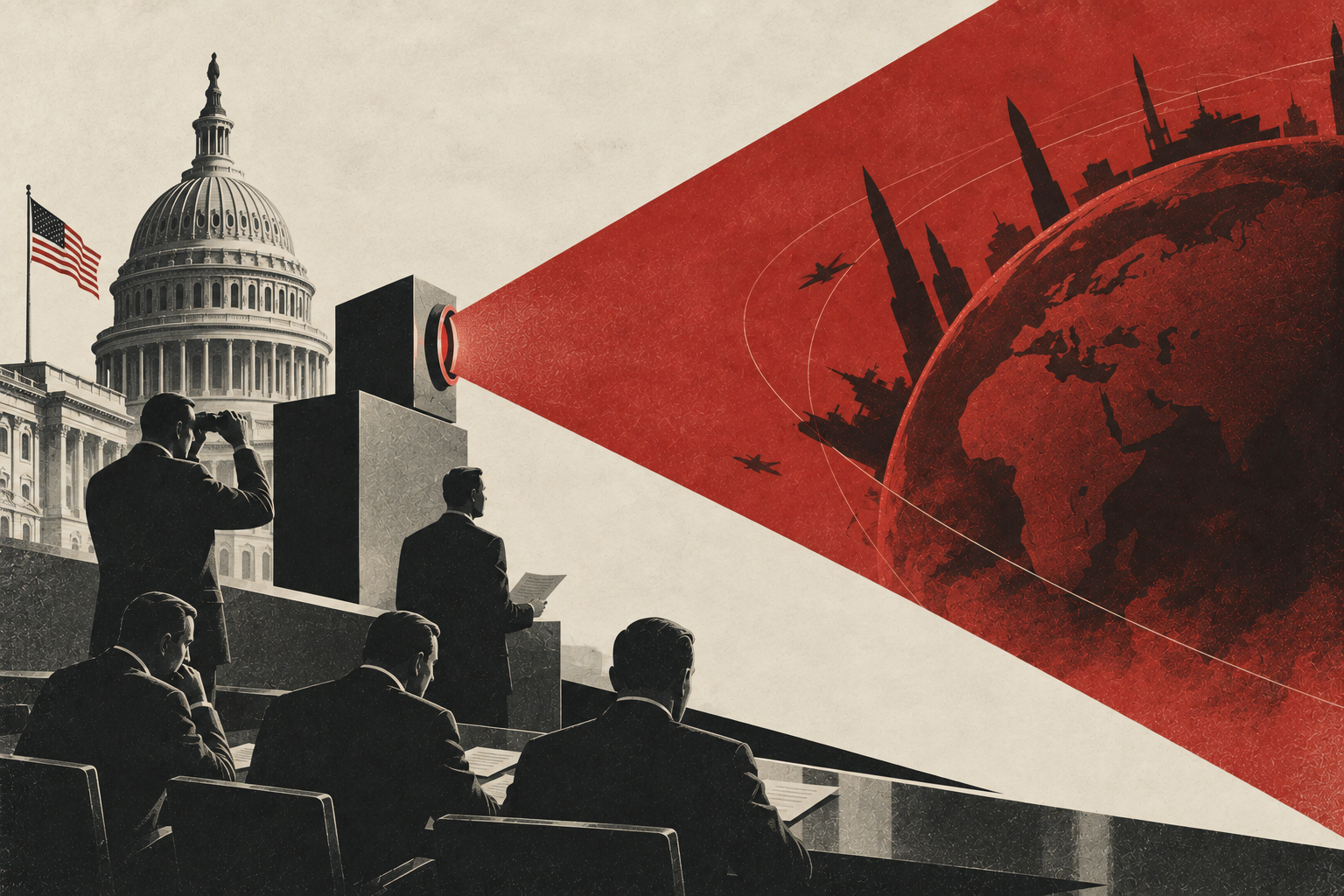
Institutional threat inflation in American foreign policy
The Arithmetic of Alarm
July, Moscow, 1955. The shadows here in summer do not behave as they do at home. The light persists so long into the evening that darkness never seems to fully arrive, and what shadows there are fall at angles that make distance difficult to read. You know this about Moscow. You know other things too: which restaurants to avoid, which routes are watched, what a smile means when it is held a beat too long. You have been the American air attaché to the Soviet Union for fourteen months now, and though air attaché is a title that can mean many things, you understand your function precisely. You are an instrument of collection. You are here to watch and to count and to report what you have seen.
Tushino Airfield, northwest of the city. The reviewing stand fills with uniforms; Soviet, American, British, French. You find your seat among them. The Soviets have done this deliberately, this opening of the show to foreign eyes. They want to be seen. They want to impress.
When the first bomber formation arrives, it comes over from the east. The aircraft are unmistakably Bison; the swept wing, the four buried engines, the fuselage that tapers to nothing at the tail. You have studied these aircraft from photographs, from what little had come through channels, from the Aviation Week piece published eighteen months ago that set the air intelligence community briefly on fire. You count them as they pass overhead. Ten planes. You write the number in your notebook. The sound goes with them as they disappear east. You have been counting things in the air since before the war ended. You know how to count.
Then, surprisingly, a second formation. You count again. Eighteen more. Your pencil moves. You are aware, distantly, of something tightening in your chest; not panic, nothing so unsteady as that, but the quiet locking sensation of a number that means something. Twenty-eight Bison. Twenty-eight aircraft capable of delivering a nuclear weapon to the American continent. This is more than you thought they would have. You extrapolate, as you have been trained to extrapolate; production rates, fleet projections, the arithmetic of strategic parity. By 1960, the number you are already constructing in your mind runs to hundreds. The word gap is not yet in circulation, but you can feel the shape of it.
You do not know, you cannot know, from where you are seated, that you have already counted those planes. That the sky had shown you the same thing twice. That the number in your notebook, written in your own careful hand, is the precise measure of a gap that does not exist, and will never exist.
[ 1 + 1 = 3 ]
In the years immediately following the Second World War, the United States found itself in the unfamiliar position of having to assess a rival it could not see. The Soviet Union was a closed system, territorially vast, politically opaque, and deliberately hostile to the kind of visibility that intelligence requires. What the West knew about the Soviet military capability in the early 1950s could be held in a very small room. Into this void came inference. When direct observation is impossible, analysts do what analysts are trained to do; they reason from what is visible toward what is not, watching the edges of the system for the information the center withholds. The problem with inference is that it is only as reliable as the data it begins from, and the Soviet’s understood this. The annual air shows at Tushino Airfield, northwest of Moscow, were open to foreign military attachés. The aircraft that flew over the reviewing stand were designed not to display the reality of Soviet capacity, but to enter the American intelligence system and shape the contours of its strategic imagination.
In July 1955, at the Tushino demonstration, ten Myasishchev M-4 “Bison” bombers, a Soviet jet aircraft only recently revealed to Western intelligence, and capable, it was believed, of delivering a nuclear weapon to the American continent, flew past the airfield’s reviewing stand, disappeared to the east, looped back unseen, and flew past again, this time with eight additional Bison. The American air attaché, Colonel Charels Taylor, counted twenty-eight bison in all, just as the Soviets wanted him to. He was correct. He had seen twenty-eight aircraft. What he could not know, from where he was seated, was that he had double counted ten of those planes. The Soviets only had eighteen. The geometry of the airfield, the timing of the maneuver, and the direction of the approach made it structurally impossible for him to know that. He filed his report that evening. Twenty-eight bison. No one imagined the Soviets had that many.
What followed was a system operating as systems do. Taylor’s count traveled upward through the American intelligence apparatus, each desk adding weight to the number without subtracting doubt. Analysts extrapolated from the count to production rates, from production rates to fleet projections, from fleet projections to a conclusion that the Soviet Union would field eight hundred strategic bombers by 1960. The input was wrong. No instrument then available could have revealed it.
Senator Stuard Symington of Missouri, first Secretary of the Air Force, presidential aspirant, chairman of the 1956 Airpower Subcommittee, concluded from Taylor’s count that the Soviets already possessed more strategic bombers than the United States, and that unless the Air Force received substantially more funding, the Kremlin would achieve strategic superiority between 1958 and 1960. The “bomber gap”, as the idea came to be known, had become a political fact, which is a different and more durable thing than an ordinary fact because political facts have the capacity to generate additional political facts. The “bomber gap” generated a policy of military buildup, which generated appropriation, which generated four thousand American strategic bombers across eight variants. The Soviet Bison fleet, at its peak, never exceed one hundred and seventy-three.
President Eisenhower was skeptical about the existence of this gap from the beginning. He had spent his career in proximity to military institutions and understood, better than most, how the services translated uncertainty into budget requests. He resisted the pressure to expand production of American warplanes and was punished for it. His approval ratings fell when he refused to match the alarm with spending, and his influence over American politics began to wane. Senator John F. Kennedy made the bomber gap a key campaign issue in 1960, accusing the Eisenhower administration of dangerous complacency. He assumed the presidency in January 1961, defeating Eisenhower’s Vice President, Richard Nixon.
The Air Force of the 1950’s had come from a war in which production had equated to survival, in which counting the enemy’s capabilities and building enough of your own was the correct and necessary response to problems as they actually existed. When Taylor’s count arrive, it entered a professional community whose entire vocabulary had been organized around exactly the kind of problem twenty-eight Bison bombers fit into. The apparatus was waiting, and once it received the input it needed, it immediately understood it in the terms the apparatus supplied: production rates, force projections, strategic sufficiency. The apparatus processed the information with complete professional competence and arrived at a wrong conclusion, because the apparatus was not designed to ask whether the information might be the same aircraft seen twice. The expertise was genuine. It was also a cage. Competence and blindness compound together, as they always do, because they are not opposites. They are expression of the same underlying organization of attention. You cannot learn to see one thing without simultaneously learning not to see another.
What the system did next is more instructive than the original error. When Eisenhower resisted, when the man with the most direct institutional experience looked at the evidence and concluded the gap was overstated, the system produced consequences for his resistance. His approval fell. His judgement was characterized as complacency. The political environment penalized reassurance and rewarded escalation because escalation generates responses, and responses generate constituencies, and constituencies generate careers. Symington understood this intuitively. The budgeters in the Airforce, and their contractors, understood it professionally. Neither needed to lie. The system produced the preferred conclusion through the ordinary operation of incentive, the way water finds the lowest point without deciding to.
Eisenhower named what he had observed on his way out of office, in January 1961, in a farewell address that is remembered now mostly for the phrase “military industrial complex”. But it was, in its full form, a precise structural diagnosis. He had watched, over two terms, the emergence of a permanent armaments industry with the institutional weight to generate its own demand, to produce the threat perceptions that justified its own expansion, to penalize the politicians who questioned the alarm. He said it as he was leaving because saying it earlier could have cost him more than his approval ratings. Even the man who saw the mechanism most clearly could only speak plainly about it when he had nothing left to lose.
This is the first and most innocent form of the arithmetic of alarm. The input is corrupted at the source. The analysis is internally sound. The institutional environment receives the result with enthusiasm proportional to its usefulness and penalizes those who question it with an efficiency that requires no coordination and no malice. One plus one has been made to equal three. The equation is legible, as is the solution. The input is wrong. And by the time the error is fully understood, the production lines have been running for years, the institutions built around the threat have acquired their own momentum, and the men who were right have already paid for being right and mostly stopped saying so.
December, Washington, 1976. The room is not large. You have been in this building for four years and you know its specific cold, the air that comes off the marble in the lobby, the particular quality of fluorescent light in the sub-basement where the files are kept. You know how a classified document feels in your hands, the weight of the paper, the resistance of the cover. You have spent four months on this assessment. The binders are tabbed. The sourcing is rigorous. The production rates are charted against every satellite pass over the relevant facilities. You believe, with the confidence of someone who has checked her work, that you know what the evidence says.
Nitze rises. He is seventy years old. He was at the table when they built the architecture of this entire world: the bombs, the treaties, the doctrine, the deterrence. When he speaks, he does not cite figures the way you cite figures. He speaks about Soviet intention as though it were a geological fact, a thing that does not require sourcing because it is simply visible to anyone who has paid sufficient attention over sufficient decades. The Soviets, he says, believe they can fight a nuclear war. They believe they can win one. The evidence for this is not in the hard data, not in the satellite imagery, not in the technical assessments, but in what they say, in their doctrine, in what any honest reader of their literature would conclude. He says the word honest without emphasis, which is how you know it is directed at you.
You present your assessment. You are precise. Your hands are steady. You watch a man across the table write something in the margin of his notepad and you find that you cannot stop watching his pen. Concern, you say. The evidence supports measured concern, not military buildup. You wait for the methodology question, the sourcing question, the question about confidence intervals. They do not come. What comes is the weight of the room, which has already decided something, which decided it, you will understand later, before anyone walked through the door. Afterwards someone will tell you, not unkindly: Nitze ate us for lunch.
You will think about the word us for a long time. Outside, December. The Potomac somewhere beyond the buildings, grey and cold and indifferent to your conclusions.
[ 1 + X = Y ]
The mid-1970s were years of institutional exhaustion in American foreign policy. Vietnam had ended badly and visibly, Watergate had gutted the executive, and the Church Committee had spent two years excavating the CIA’s darkest programs, the debris of two decades of covert action. The agency emerged diminished, its authority questioned, its culture of secrecy cracked open to public view. Into this environment of institutional uncertainty came détente; Henry Kissinger’s architecture of managed competition with the Soviets, strategic arms limitation, and deliberate subordination of ideological confrontation to diplomatic stability. For a significant faction of the American right, détente looked a lot more like acquiescence. The CIA’s annual National Intelligence Estimates (NIE) of Soviet military capability, which tended toward measured assessment rather than maximum alarm, proved it.
The challenge to those estimates did not come from new intelligence. It came from a decision about process. In 1975, the President’s Foreign Intelligence Advisory Board, a body of prominent conservatives appointed to oversee the intelligence community, asked CIA Director Willaim Colby to authorize a competitive assessment to the NIE; an outside panel that would review the same classified evidence the CIA used and produce an alternative conclusion. Colby refused. He stated that it was hard to envision how an ad hoc independent group could prepare a more thorough assessment than the intelligence community itself. This was a reasonable position. It was also, evidently, the wrong answer. Colby was removed from his post in November 1975 in what became known as the Halloween Massacre; a purge of the national security establishment that historiography suggests was driven by Donald Rumsfeld’s lobbying from his position as Secretary of Defense. Colby’s successor, George H.W. Bush, authorized the competitive assessment within months of taking the job.
The panel that was assembled, known as “Team B”, was not composed of neutral analysts asked to approach the evidence with fresh eyes. The founding mandate for the panel specified that members should be selected from those known to take “a more somber view” of the Soviet strategic threat. The conclusion, in other words, was written into the selection criteria. Team B was asked to make the strongest possible case that the CIA was wrong, and its members, drawn from the most hawkish precincts of the American national security establishment, were chosen precisely because they had already spent years making exactly that case in think tanks, congressional testimony, and journal articles. Richard Pipes, a Harvard historian of czarist Russia who chaired the panel, had been publicly committed to a maximally alarming view of Soviet intentions for the better part of a decade. Paul Nitze, the panel’s elder statesman, had helped write NSC-68, the 1950 document that had established the template of Soviet threat inflation as a tool of defense budgeting. Paul Wolfowitz, the most junior member of the panel and a key architect in the 2003 invasion of Iraq, was thirty-three years old and already a disciple of the school of thought these men represented.
What Team B produced, over four months of intensive work in the summer and fall of 1976, was an argument assembled with the all the classical forms of rigor; footnotes, classified sourcing, methodological preamble, but structured to reach a predetermined conclusion. The CIA’s analysts relied on what Team B called “hard data”, satellite imagery, signals intelligence, technical measurements of actual Soviet hardware. Team B argued that this reliance on the verifiable was an error. The CIA was too literal, too empirical, too unwilling to infer Soviet intention from Soviet ideology and doctrine. The difference was not in the evidence. It was in the interpretive framework applied to the evidence, and Team B had chosen its framework before reviewing a single document.
The specific predictions Team B made have since been declassified and assessed. They were, with near-total consistency, totally wrong. The report predicted the Soviet Backfire bomber would probably be produced in substantial numbers, with perhaps five hundred aircraft operational by 1984. In 1984, the Soviets had two hundred and thirty-five. It claimed the Soviets were developing a non-acoustic submarine detection system, a technology that would allow them to track American submarines without sonar, rendering the entire American submarine deterrent potentially vulnerable. No evidence existed for such a system. Team B’s response to the absence of evidence was that it must already have been deployed because it appeared to have evaded detection. The absence of evidence was offered as evidence of sophistication. The framework was, in short, unfalsifiable; any data point that contradicted the alarmist conclusion could be reinterpreted as proof of Soviet capability.
Team B presented its findings alongside Team A’s assessment to the President’s Foreign Intelligence Advisory Board on December 2nd, 1976. By all accounts, the CIA’s analysts were overmatched, not because their evidence was weaker, but because they were operating by different rules in the same room. Team A presenting findings with appropriate confidence intervals and sourcing caveats. Team B presented conclusions with the force of conviction. Team A was expressing measured concern. Team B was expressing alarm. Alarm won. The subsequent NIE, issued on December 21st, described the Soviet Union’s ultimate goal as achieving dominant position over the West and acknowledged Soviet doctrine as calling for capabilities to fight, survive, and win a nuclear war. George H.W. Bush, in his cover letter described it as presenting a starker appreciation of Soviet strategic capabilities than previous estimates had offered.
The findings were leaked to the press within weeks of Jimmy Carter’s election, timed to inflame conservative opinion regardless of which party won the White House. They became the intellectual foundation for the concept of the “window of vulnerability”; the claim that a period of American strategic weakness was approaching, resulting in the massive arms buildup that began under Carter and accelerated dramatically under Reagan. The members of Team B did not disperse when the exercise concluded. They reconvened almost immediately as founding members of the Committee on the Present Danger, whose inaugural policy statement was written by Richard Pipes. Several went onto senior positions in the Reagan administration. Pipes served on the National Security Council. Nitze became a principal arms control negotiator. The exercise which was meant to produce a document had also produced a cohort; a network of men whose worldview had been validated, whose access had been formalized, and whose methods had been proved to work, even if their conclusions were wrong.
To describe this simply as cynicism or bad faith is to miss what made it durable. The men of Team B were not, for the most part, lying. They genuinely believed the Soviet Union was more dangerous than the CIA acknowledged. They had organized their professional lives around that belief. They had given speeches about it, written books about it, testified to Congress about it for years. The belief and the believer had become, over sufficient time, indistinguishable and inseparable, capable of seeing one worldview with extraordinary clarity at the expense of all others, even when that worldview was inaccurate. When Pipes argued that Soviet doctrine called for nuclear warfighting, he was not fabricating. He was reading Soviet military literature through a framework he had spent a career constructing, and the framework returned the reading he had always expected. The expertise was genuine. The expertise, again, was also a cage.
This is a more subtle and more important form of the arithmetic. The bomber gap had produced a wrong answer through the inadvertent corruption of an input. Team B produced a wrong answer through the corruption of the process itself, by selecting analysts for their conclusions, by designing a methodology that could not produce a disconfirming result, by building a framework so internally coherent that no evidence could penetrate it from the outside. The institutional medium had fully shaped the message. The form had produced the finding. And the people inside the framework experienced this not as a distortion, but as clarity.
The national security world selects for a specific relationship with uncertainty; not the tolerance of it, but its conquest. The men who rise are rarely the ones who say we cannot know. They are the ones who say we do know, who convert the irreducible ambiguity of a closed and hostile world into a settled picture, who mistake the resolution of their own doubt for contact with the truth. When someone in authority confirmed that their instruments had been reading correctly all along, it felt, to the men of Team B, like the end of a long argument with the world. The horror of uncertainty, which is the permanent condition of anyone in this space, resolved into the love of a felt mastery, the sense of seeing clearly what others had been too cautious or compromised to see. The feeling is extraordinarily difficult to distinguish from genuine insight. It is also, in these circles, extraordinarily well rewarded. The alarm is not incidental to the influence. It is the source of it.
The Soviet Union against which this apparatus was aimed began its terminal decline in the same year Team B issued its report. By January 1977, Brezhnev had given a speech in the Siberian city of Tula signaling a retreat from the most aggressive Soviet military postures, a speech that, in retrospect, marked the beginning of the process that led to Gorbachev and the Soviet collapse. Team B had described an enemy achieving dominant strategic position at precisely the moment that enemy was beginning to come apart from within. The apparatus had taken one real number, Soviet military capability, genuinely formidable, genuinely worth assessing, and added to it a variable of its own construction; intention, doctrine, the will to fight and win a nuclear war. It had selected this variable not from the evidence but from the conclusion the framework required. One plus X had produced Y. Y was wrong. It led to the largest peacetime military buildup in U.S. history, billions of dollars in nominal terms spent to counter a Soviet threat deemed existential and permanent. The Soviet Union collapsed under the weight of its own contradictions in 1991.
November, Fallujah, 2004. The city smells of smoke and something beneath the smoke that you have stopped trying to name. You are nineteen years old. You know this about yourself the way you know the weight of your rifle, which is to say you know it without thinking about it, which is to say it is no longer interesting information.
The street is concrete and rubble and a single plastic sandal, child-sized, left in the middle of the road. You have learned not to look at things like that. You have learned, in the three days since the assault began, a series of practical things: how a door sounds different when something is wrong with it, how silence accumulates differently in rooms that are occupied, how the back of your neck knows before your eyes do.
Ahead of you, David. You have known David since Lejeune. He is from a town in Ohio you have never visited and intend to visit, someday, when this is over. He has a sister. He has told you about the sister. He walks the way he always walks, weight forward, rifle up, moving through the space between the last cleared house and the next one with the particular attention of someone who has learned that attention is what keeps you alive.
The wall to your left is pocked with old impacts. The morning light comes in low and flat. Somewhere above the city, an aircraft; the sound so constant now it has become part of the silence, the way a river becomes silence once you have lived beside it long enough. David is at the corner. You are watching the back of his neck. You are thinking about the sister.
Then a crack. AK. Close, from the second floor of something to your right, and David goes down. Not falling in the way people fall in films but folding, a sudden subtraction, the weight going out of him all at once.
And you are moving before you know you are moving. This is what the training is for. You reach him. You do the things you have been taught to do. Your hands know what your mind has not yet processed. His eyes are open, and he is looking at something above you, above the roofline, above the city, somewhere you cannot follow.
Later, much later, in a different country, in a different life, someone will explain to you the sequence of decisions that brought you to that street. The assessment. The estimate. The fixed intelligence. The case that was made in rooms you will never see, by people who will never see this street, this wall, this particular angle of November light. They will use words like mistaken and flawed and insufficient. They will not use the word David.
You already knew all of this, of course. You knew it the way you knew your age. Without thinking about it. The way you know it now, kneeling on the concrete of a street in a city whose name you will carry in your body for the rest of your life, your hands pressed against something that cannot be stopped.
[ X + Y = Z ]
Something had changed in the decades between Team B and Iraq, and it’s easy to mistake what that change was. The easy version is that the Bush administration lied, that officials knew the intelligence was weak and made the case anyway, that the Office of Special Plans selected what it wanted and discarded the rest, that Curveball, the yellowcake, the aluminum tubes were all known to be unreliable pieces of intelligence and used regardless. All of this is true. None of it is the point.
Intelligence analysis is, by its nature, a truth-seeking practice. Truth, or something approaching it, is its product. It has internal standards even when imperfectly applied. It produces dissenting footnotes in key documents. It sends inspectors to the sites in question. It acknowledges gaps. The analysts who wrote caveats in the 2002 NIE were doing their jobs. The inspectors who went to Iraq and found nothing were doing theirs. The practice was present. It simply wasn’t the thing driving the decision.
The political class operates by a different standard entirely. Politicians, staffers, think tankers, war gamers, former officials cycling through contractor boards and back into government; their product is narrative, which does not need to be true, only believed. Belief is manufactured through repetition, through institutional authority, through self-referential loops so dense they feel like consensus. The think tank paper shapes the landscape. The landscape shapes the analyst. The analyst writes the NIE. The NIE validates the think tank paper. The cable news segment cites both. The contractor who funds the think tank sees the coverage. The senator who receives the contractor’s contributions calls for more spending. The spending justifies the next think tank paper, which is read by the analyst writing the next NIE.
Each pass through the loop adds authority. Each iteration pulls more people into its orbit and moves one step further from the physical world the loop was originally meant to describe. Eventually the loop does not describe the world at all. It describes itself which only increases its confidence. The contractors, who have no function in the absence of threat, who exist precisely because the loop keeps turning, are the weight that keeps it spinning. Constituency is the profit of this narrative work; enough people who believe in the narrative to move funding, to make specific policy decisions, to arrive at specific conclusions.
Into this environment came 9/11 which superheated everything. Decades of institutional threat inflation had prepared a public and a political class for exactly this moment. The attacks provided the permission to act on conclusions the neoconservative policy establishment had been generating for years. The intelligence community went to Iraq and found nothing. Their findings were processed by a political ecosystem that had long since evolved past the need to incorporate findings that disrupted its narrative. The constituency for alarm, as it always is, was vast.
What all political ecosystems ultimately produce, at sufficient density and over sufficient time, is a condition in which the language they use to describe the world loses its connection to its referent. A word begins as a gesture toward something real; a country, a threat, a weapon, a necessity. It is a compression, a representation, a tool built to make the thing it describes portable enough to think with. But a word is not the thing. The thing exists in the physical world, with weight and heat and density. The word exists in the mind, in the mouth, and on the page, and it is useful precisely because it can travel where the thing cannot. The danger with words is what happens when they travel so far from the thing they represent, when they pass through so many institutional hands, when they get cited and recited and embedded in so many documents that the original gesture, the reach toward the physical world that gave the word its meaning, is forgotten. The words keep circulating, the authority they have accumulated through repetition keeps compounding. But they no longer point at anything. They become pure sound in the way all words do when you repeat them continuously; resonant but hollow, a void of meaning into which anything can be poured. Any country, any threat, any necessity.
The Iraq War was a war birthed inside this loop. Inside that system the decision to invade was not only coherent, but obvious, the conclusion already present in the premise, the answer legible before the equation was written. This is how the American foreign policy establishment got to Iraq. Not through lies, or at least not lies alone, but through the weightlessness that comes when a narrative has been running long enough, through enough institutions, citing enough of itself, that it no longer requires the world to confirm it. X plus Y equals Z, where X and Y are themselves products of the loop, and Z was never in question.
The loop did not stop when the war ended. It absorbed the war, processed it, and continued turning. The same institutions that built the case for Iraq built the case for the next set of conclusions the ecosystem required. The same contractors needed the next threat. The same think tanks needed the next paper. The same cable segments needed the next talking points. The words that had hollowed out over Iraq filled again with new content, new countries, new necessities, their authority undiminished by what had happened the last time they circulated. A loop that can absorb its own failure without correction is not a loop that can be stopped by failure. It can only be stopped by something the loop has no mechanism to produce; contact with the thing the words were originally built to describe.
That contact has not come, at least not fully, and certainly not to the policy establishment making decisions. Most Americans watched the war in Iraq sitting in their living rooms, their experience of the conflict mediated by various nodes of the self-referential loop. The policy establishment thought about the war, contributing a flood of ideas and analysis that were only legible inside the loop. The only population that truly experienced the war, the soldiers on the ground, had no real means of criticizing the war in the moment, and have had nothing but universal condemnation for the war since, most of which has gone unheeded.
As of this writing, we are standing on the precipice of another middle eastern war, of a military buildup to counter an adversary in China that mirrors the buildups that contributed little, if anything, to the collapse of the Soviet Union. The ecosystem is more sophisticated than it was in 1956, more confident than it was in 1976, and denser now that it was in 2002. The loops are tighter, the layers more numerous, the contractors better funded, the think tanks more influential, the distance between the words circulating at the top of the apparatus and the physical world greater than it has perhaps ever been. There are countries whose names are already moving through the loop, accumulating the weight of institutional repetition, approaching the condition of pure sound. That sound is familiar. We have heard it before. It arrived in the hearings that justified four thousand bombers. It arrived before the window of vulnerability that justified a buildup the Soviet Union was already too weak to match. It arrived before the aluminum tubes and the mobile labs and the “slam dunk” that justified a war that killed nearly a half a million people and produced nothing it promised. The sound is not a signal. It is what remains when the signal has been processed so many times, through so many institutions, cited and recited and embedded in so many documents, that the original gesture towards the physical world has been lost entirely. It is the sound of the loop, confident and hollow, demanding a response. We have a word for it. We call it alarm. We should be very careful about what we give it.