Maritime security and the cost of trade
The Repricing of Order
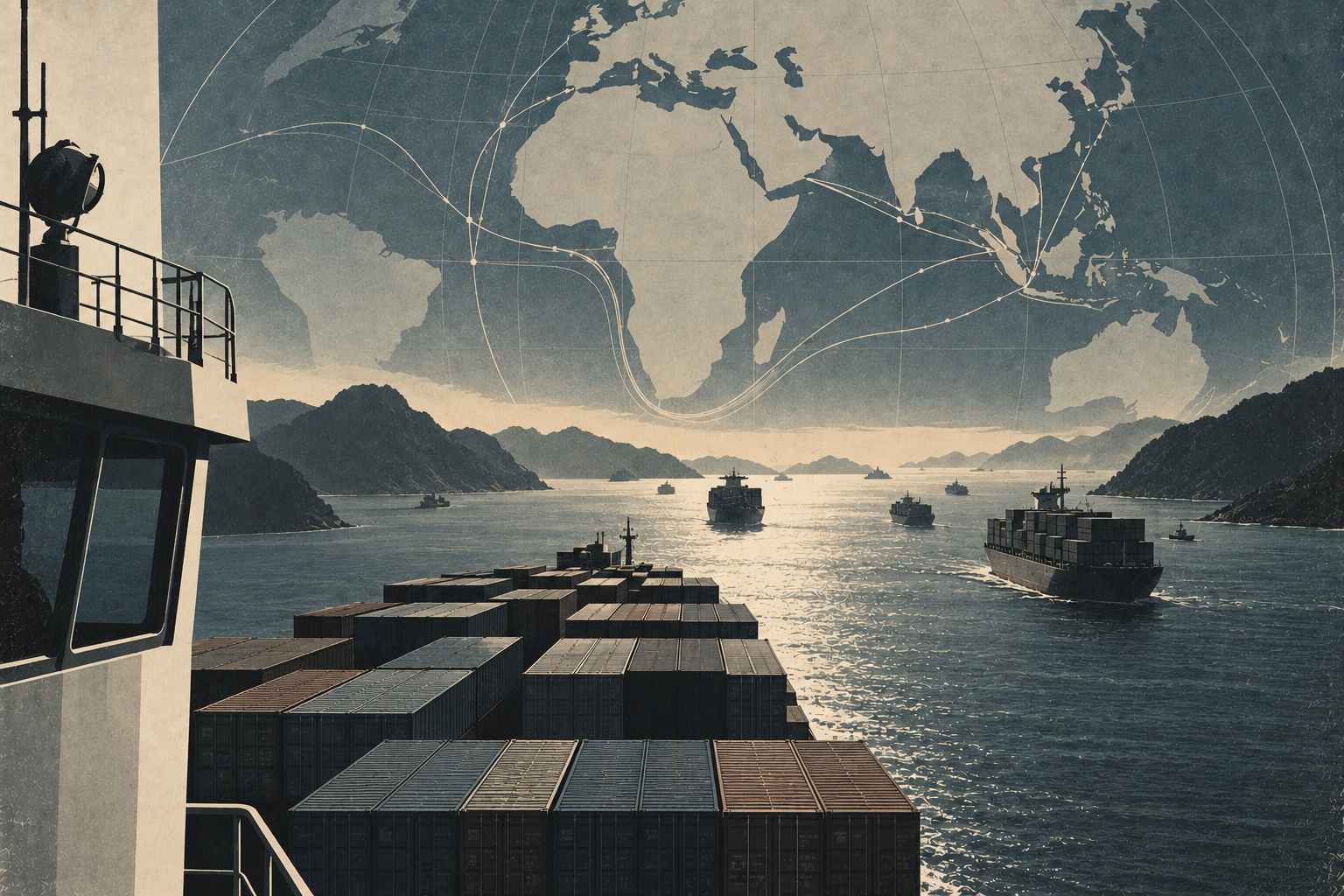
At 6:37 a.m. GMT, before the coffee had cooled beside the underwriting terminal, the revised notice from Lloyd’s Joint War Committee appeared on the screen: vessels transiting the Strait of Malacca would be subject to an additional war-risk premium following a week of boarding incidents attributed to an armed maritime network operating off Sumatra’s western coast. The surcharge was not dramatic, a fraction of a percent on hull value, but across a 180,000-ton container ship carrying semiconductors, machine tools, and refrigerated foodstuffs bound for Rotterdam, it translated into several hundred thousand dollars, on this voyage alone. On the desk nearby, the overnight cables from Singapore detailed rerouted traffic and delayed transits; AIS tracking maps glowed with clusters of vessels idling east of Penang. Nothing had sunk. But in the quiet recalibration of probability, the cost of passage through one of the world’s busiest chokepoints had inched upward, and with it the assumptions that had long made distance cheap.
This is a fictional scenario, and in the postwar era, adjustments like this are rare enough to feel temporary; deviations from a broader assumption that the sea, however congested, however contested in theory, remains open in practice. Its risks are priced modestly because its passages are underwritten by a naval presence so constant that it fades into the background of global commerce. Insurance premiums, cheap and stable, reflect that security. Freight contracts are written around predictable transit. Supply chains lengthen under the protection of sustained naval enforcement. The cost of distance is, in effect, subsidized by a stability so persistent that it ceases to be noticed. Yet that stability is neither permanent nor free. It rests on sustained naval deployment, intelligence coordination, forward basing agreements, and the willingness of a single power to absorb the cost of keeping sea lanes open even when the beneficiaries are dispersed across continents. Today, the United States performs that role with such regularity that it more closely resembles a feature of geography rather than a policy choice. But underwriting depends on surplus capacity and political consent, both of which are finite. As capacity tightens, consent must work harder. Deployments that once felt automatic become discretionary. And discretion invites repricing.
A Brief History Lesson
In the beginning there was want. There was not enough here, and too much there. Surplus grain where there were limited mouths, excess timber where no ships were being built, salt with no meat to cure. Man noticed. Exchange followed. My surplus might answer your deficit if yours answered mine. But between us stood distance; indifferent, unmoving, vast. Distance was the first tax on exchange. To trade, men had to compress it.
Land resisted. It swallowed wheels and animals and time. Water, by contrast, offered relief. It carried burdens for free. Ships glided on liquid throughfares where carts would founder; a single current could perform the work of a hundred shoulders. So man congregated along riverways. The Nile, the Indus, the Tigris and Euphrates. *Homo Fluvialis. *When we grew confident, we harnessed the sea and became masters of water. Homo Aquaticus. The sea enlarged our world, made trade among distant tribes possible. It also exposed us to predation. There are always men who prefer seizure to bargain, who find it simpler to take than to tally.
And so commerce and violence were born twins. A merchant leaving Alexandria or Lisbon calculated not only wind and tide, but risk of seizure. Barbary corsairs extracted tribute from European powers for centuries. Along the Swahili coast, dhows moving between Gujarat and Zanzibar sailed beneath rival flags and cannon, tribute and toll extracted at straits and harbors alike. Even in the age of sail’s high empires, shipping lanes were secured by force, not custom. The sea rewarded scale and invited plunder in equal measure.
Maritime stability, when it finally came, was not an accident of geography but part of a larger exchange, one in which security commitments were traded for economic openness, and the cost of policing the commons was absorbed by the power that stood to benefit most from a stable system. That exchange extended well beyond the waves. It was formalized in a monetary and institutional architecture than anchored currencies to the dollar, opened markets to trade, and positioned the United States at the center of the system whose stability it helped guarantee. The arrangement was neither altruistic nor purely extractive; it aligned American security commitments with American economic advantage. A reserve currency required deep and liquid markets. Expanding trade required predictable transit. Both depended on the credible assurance that goods could move without interdiction and contracts could settle without disruption. Naval presence and monetary centrality were not separate policies. They were complementary pillars of the same order institutionalized at Bretton Woods and sustained by Pax Americana.
Material Constraints
An order of that scale does not sustain itself by abstraction. It rests on material capacity. The monetary architecture and the security architecture are distinct in form but identical in dependency; both require credibility. Credibility, in turn, depends on the visible ability to deploy force at a scale without hesitation. That ability is not conceptual. It is industrial, fiscal, and political.
An order sustained by naval predominance requires ships, crews, maintenance cycles, forward basing, and political consent. It requires presence not in theory but in rotation; carrier strike groups that can deploy simultaneously across oceans, destroyers that can escort through chokepoints, logistics vessels that can sustain operations far from domestic ports. Maritime peace is expensive not because conflict is constant, but because the capacity to prevent it must remain credible. For all the abstract talk of presence and patrols, the calculus of forward deployment is grounded in very real consumption. A modern U.S. carrier strike group, with its nuclear-propelled flattop, its ring of cruisers and destroyers, its submarine screens and support vessels, does not float on goodwill. It consumes resources at scale. Even nuclear-powered carriers, which do not require conventional fuel for propulsion, must sustain an air wing and escorts that do. Operating a deployed carrier strike group costs on the order of $6-8 million per day, roughly $250,000 to $330,000 for every hour it remains at sea. This is before a single missile is fired. Under normal peacetime posture, the United States forward deploys two to three such groups at any given time, with another typically transiting or in short-notice readiness. In crisis, the Navy can surge five or six strike groups temporarily, but not indefinitely. Sustaining just two to three strike groups continuously forward therefore requires between $5-8 billion annually, before accounting for shipbuilding, overhauls, pensions, or the broader fleet that makes such deployments possible.
Expense, however, is only the visible portion of the commitment. Time is the harder constraint. Modern surface combatants required years to construct and longer to commission; nuclear-powered submarines and aircraft carriers operate on timelines measured not in quarters, but in political cycles. A Virgina-class submarine takes roughly five to seven years from keel to delivery under optimal conditions, and aircraft carriers longer still. Even when funding is authorized, production depends on shipyards operating with finite throughput, on specialized suppliers producing components that cannot be substituted at scale, and on a workforce trained over decades rather than assembled on demand. Capacity in this sector is not elastic, it is industrial.
Nor is fleet size synonymous with deployable presence. Vessels rotate through maintenance availabilities that frequently stretch beyond planned schedules, as shipyards contend with backlog, labor shortage, and deferred repair from years of high operational tempo. A destroyer in extended overhaul does not patrol a chokepoint. A submarine awaiting refit does not escort tankers. The gap between total hulls and forward availability is where surplus resides and where it can quietly disappear. The postwar order assumed that surplus capacity existed; more hulls than strictly necessary, enough industrial depth to replace losses or expand presence if required, and a margin of political tolerance to sustain forward deployment even when the immediate economic benefit was diffuse. Today, the arithmetic is tighter. The fleet is smaller relative to global trade volume than it was at mid-century. At the height of the late Cold War, the Navy approached 600 battle force ships; today it operates with roughly half that number, even as global seaborne trade volumes have multiplied many times over and chokepoints have grown more economically consequential. Maintenance availabilities increasingly overrun their schedules, and shipyard throughput is constrained by workforce, infrastructure, and industrial bottlenecks that cannot be remedied by appropriations alone. None of this implies retreat; it implies constraint, and constraint implies selectivity.
What would that selectivity mean in practice? It would mean that coverage becomes conditional. Not every corridor would receive the same guarantee, and not every crisis could be met at once. Enforcement would be sequenced. Presence would rotate with greater consequence. Some regions would be over-insured, other exposed. In a system calibrated for simultaneous reassurance, exposure is not neutral. The chokepoints are where this exposure manifests. Global trade is not evenly distributed across the seas but funneled through a handful of straits and canals where geography dominates. The world economy is wide; its arteries are narrow. These chokepoints are where presence must be continuous rather than symbolic and where absence is immediately priced.
The Repricing of Order
Four corridors carry a disproportionate share of global commerce, and each concentrates a different form of risk. The Strait of Malacca is largest by volume, a key link in the corridor that carries roughly a third of global shipping and much of east Asia’s imported energy. At its narrowest point it is less than two miles wide. Its vulnerability is geographic compression; immense throughput forced through a channel that cannot widen when tensions rise. The Strait of Hormuz is smaller in scale but more acute in consequence. Nearly one-fifth of globally traded petroleum transits its lanes. Its weakness is geopolitical concentration; a narrow passage bordered by rival states where even limited harassment can reverberate through energy markets. The Suez Canal represents engineered compression. It shortens Eurasian trade into a single artificial corridor whose disruption instantly lengthens voyages by weeks. A single grounded vessel in 2021 halted nearly 12 percent of global trade, not through conflict but through mechanical failure. Finally, the Panama Canal illustrates a different constraint. Its vulnerability is not adversarial but hydrological. Drought in 2023 reduced daily transits, demonstrating that chokepoints are exposed not only to politics and force but to climate and infrastructural limits.
Chokepoints are where the abstraction of free trade becomes a question of hulls, basing rights, and repair schedules. They are where the cost of insurance concentrates. The postwar system functioned because the United States could afford to over-insure these arteries, to maintain enough excess capacity that a crisis in one did not require stripping another. But as this surplus narrows, selectivity will follow. A world that requires a legitimate naval presence at Panama is still a world that requires a legitimate naval presence at Suez. A crisis at Hormuz may be amplified by a crisis at Malacca. The United States does not have the navy required to police a fragmented global order some policymakers seek. Selectivity, in their mind, is a decision of emphasis made in the context of universalism. We can, of course, deploy assets to Venezuela, interdict shadow fleet tankers in the Atlantic, project power over the skies of Iran using aircraft flying from carriers off Hormuz, while still protecting sea lanes near Malacca and Panama, and conducting freedom of navigation operations in the South China sea. But we cannot do all of this simultaneously. At a certain point, there is too much toast, and not enough butter. Gaps emerge. Actors take advantage.
Markets understand these dynamics even when policymakers do not. Marine insurers do not speak in strategy documents; they speak in basis points. When tankers were struck near the Strait of Hormuz in 2019, war-risk premiums for vessels transiting the Gulf reportedly tripled within days. When missile and drone attacks spread across the Red Sea in 2023-24, insurers reclassified routes and sharply increased premiums before governments had settled on a common response. In moments of acute tension, coverage that had cost a fraction of one percent of a ship’s value may double or more in a week. On a $100 million tanker, that repricing translates into tens or hundreds of thousands of dollars per voyage, not in theory, but on the invoice.
Insurance prices move faster than speeches. They adjust before task forces assemble and before communiques are drafted. Underwriters are not voting on resolutions; they are pricing probability of loss. In doing so, they provide a real-time referendum on the credibility of order. When presence is abundant, and deterrence is assumed, premiums compress toward the background noise of commerce. When coverage appears conditional, fragmented, or overstretched, premiums spike. The effect is not merely financial. War-risk premiums function as a signal. They tell ship owners whether to sail, reroute, or wait. They tell energy traders whether supply is secure or contingent. They tell markets, more bluntly than any policy memo, whether the sea lanes are being insured in fact or only in rhetoric. In this sense, insurance markets are the nervous system of maritime order. They register stress before the body politic does. And when they spike, they are not simply reacting to missiles or mines. They are reacting to doubt; doubt that surplus exists, that simultaneous crises can be managed, that every chokepoint can be covered at once.
The numbers compound quickly. A few hundred thousand dollars on a single 180,000-ton vessel is an irritation. Multiplied across dozens of sailings per week, it becomes structural. If the war-risk surcharge rises from 0.1 percent of hull value to 0.5 percent during a sustained crisis, a $150 million container ship suddenly carriers an additional premium of $750,000 per transit before fuel, crew or canal fees. Scale that across hundreds of voyages in a month and the aggregate cost reaches into the hundreds of millions. Freight rates adjust. Charter contracts are renegotiated. Margins in already thin sectors begin to disappear. For high-value, time-sensitive cargo (semiconductors, medical components, critical machine parts) the decision matrix shifts from how expensive is passage to is passage worth the risk? Insurers may narrow coverage terms. Banks may tighten letters of credit. Shippers may wait for clarity. A handful of delayed sailings can snowball into inventory strain and, eventually, production slowdowns. Nothing need be sunk for a system to stall. As was the case during the Covid-19 Pandemic, the paralysis emerges not from destruction, but from compounded hesitation. In extremis, vessels do not sail into higher premiums indefinitely. They idle. And when enough of them idle at once, the abstraction of global trade reveals its dependency on continuous, affordable transit.
The system becomes far more brittle when repricing is not confined to a single corridor. A surcharge in Malacca can be absorbed; a parallel spike in Hormuz and Suez alters the equation entirely. Insurers do not operate with infinite balance sheets. As exposures accumulate across regions, underwriters may cap coverage, restrict transit windows, or withdraw from designated high-risk zones all together. Reinsurance markets, the quiet backstop beneath the primary carriers, tighten first. Rates do not drift upwards, they reprice abruptly once loss probabilities cross internal thresholds. A vessel that could justify one elevated premium may balk at three. Rerouting around the Cape of Good Hope lengthens voyages by weeks and adds fuel costs that compound insurance burden. Inventories that once turned predicably begin to stall in transit or sit at anchor awaiting clearance.
At that point, the question is no longer the price of passage but the availability of coverage itself. Modern shipping is financed, insured, collateralized; without adequate war-risk cover in place, banks hesitate to extend credit, charters invoke force majeure, and ports reconsider berthing rights. The choke need not be physical; it can be actuarial. If enough routes are simultaneously repriced beyond tolerance, commercial actors will do what states often refuse; they will suspend exposure. Ships idle not because they have been sunk, but because the risk cannot be underwritten at a rational premium. The result is a de facto closure of arteries without a declared blockade, a contraction of throughput driven by the mathematics of uncertainty rather than the firepower of an adversary. The order does not shatter, it hesitates. And hesitation, in a system calibrated for constant motion, is its own form of shock.
From Commons to Corridors
In a world where U.S. naval coverage is thinner, and crucially, less automatic, marine insurance stops functioning like background noise and starts behaving like signal. War-risk premiums, kidnap-and-ransom cover, cargo coverage exclusions, and named-perils policies spread from the margins to the mainstream. The effect is not just higher premiums but more conditional coverage. Tighter terms, shorter policy periods, more frequent reassessment, and abrupt reclassification of corridors when incidents cluster. What had been a small stable line item becomes a variable cost of doing business, one that moves with headlines, politics, and perceived credibility of the guarantor.
As insurance becomes volatile, so too does the economics of distance. When coverage is conditional and premiums fluctuate with each incident, distance stops being a neutral variable and starts behaving like a risk multiplier. A voyage that once felt routine now carries embedded uncertainty, not only in transit, but in cost of capital, inventory timing, and contractual exposure. Days added to a route are no longer merely logistical, they are financial, and firms respond predictably. They shorten supply chains where possible, duplicate suppliers where necessary, and carry more inventory than efficiency alone would justify. Just-in-time gives way to just-in-case. Production migrates closer to end markets not out of ideological preference but because the risk-adjusted cost of spanning oceans rises. The balance sheet shifts from optimization towards resilience, and resilience is capital intensive.
Higher costs are only the surface effect, however. The deeper shift is behavioral. Maritime violence has always been inexpensive relative to the value it can imperil. A handful of fast boats, improvised drones, or shore-based missiles can threaten cargoes worth hundreds of millions. When naval enforcement is thick and automatic, such actors are deterred or rapidly suppressed. When enforcement becomes selective, the incentive structure changes. Independent raiders do not merely disrupt trade, they extract from it in the form of ransom payments, cargo seizures, and protection rackets as informal tolls become viable revenue streams. Criminal networks gain leverage over shipping routes that pass near their territory. States, operating through proxies, acquire tools of coercion that are plausibly deniable yet strategically potent. Harassing a competitor’s energy shipment or pressuring insurers to reclassify a corridor can achieve economic effects disproportionate to the resources expensed. Disruption is cheap; reassurance is costly. In a system where confidence underwrites commerce, even limited, selective violence can yield political influence, financial reward, or strategic leverage.
Where leverage proves profitable, power follows. Opportunistic disruption rarely remains decentralized for long. Revenue streams invite consolidation; coercive tactics invite sponsorship. What begins as episodic harassment can evolve into managed access.
Regional powers step in first. A navy positioned near a chokepoint can offer “security assistance” to commercial traffic, sometimes free, but often conditional. Patrols expand, escort services formalize. Transit becomes tied, implicitly or explicitly, to political alignment. Insurance premiums reflect not just risk, but which flag provides protection. And over time the sea lanes fragment. What had functioned as global commons begins to resemble a patchwork of corridors secured by different guarantors, each with its own incentives and priorities. Passage is no longer assumed, it is negotiated. The question shifts from whether ships can sail to under whose auspices they do.
These outcomes are not foreordained; they depend on choice. The United States can choose to restore surplus capacity as a cornerstone of industrial policy, expanding shipbuilding capacity, deepening forward basing, and making explicit political commitments to open sea lanes. It can attempt to multilateralize the burden, constructing a framework in which major trading powers share the costs of securing the commons, formalizing what has long been an American underwriting function. Or it can narrow its ambitions, accepting a world of regional guarantors, fragmented corridors, and risk priced accordingly. Each path carries trade-offs. Restored dominance is expensive. Shared stewardship is politically complex. Retrenchment reduces direct burden but cedes influence over the terms of transit. The sea will not remain neutral. it will reflect the balance of will brought to bear upon it.
Maritime stability has never been self-executing. It is the product of surplus capacity and political consent, sustained at scale over time. When both are abundant, the cost of distance recedes, and risk is absorbed quietly into the system. When either tighten, that absorption becomes conditional. The consequences do not announce themselves with spectacle. They appear as incremental repricing, altered routes, longer lead times, revised clauses. Firms adapt. States test limits. Markets adjust. What had been treated as a permanent feature of the internal systems reveals itself as contingent. Trade will continue. It always does. What will change are the terms under which it moves, and who absorbs the cost.